

Every few months, the artificial intelligence industry celebrates another breakthrough. A faster chatbot. A smarter reasoning model. A new benchmark that promises to outperform its predecessors. These announcements dominate headlines and create the impression that AI's future will be decided by better algorithms and larger models. But behind the scenes, the real race has quietly shifted from software to infrastructure.
The global AI industry is now entering a phase where success depends less on building intelligent models and more on securing the physical resources required to run them. Power grids, data centres, high-voltage transformers, cooling systems, construction labour, and electrical infrastructure have become the new battlegrounds. While technology companies are expected to invest hundreds of billions of dollars in AI infrastructure in 2026 alone, many projects are being delayed—not because of a lack of capital or innovation, but because electricity, grid connectivity, and specialised equipment cannot be deployed quickly enough.
This marks a fundamental shift in the economics of artificial intelligence. Just two years ago, the world's biggest concern was a shortage of GPUs. Today, the bottleneck has moved beyond chips. Even organisations that have access to the world's most advanced processors often struggle to find enough power, cooling capacity, or grid infrastructure to operate them at scale. In other words, the limiting factor for AI is no longer compute alone—it is the physical world that supports compute.
The Chip Shortage That Quietly Ended
Back in 2023-24, every AI headline focused on one thing. GPU shortage. Companies fought hard to get enough Nvidia chips to train their models. Startups waited in line behind tech giants. Waiting lists stretched for months. Prices stayed high through this entire period. Some companies even signed deals years in advance, just to guarantee future chip supply. Getting access to enough computing power became a competitive advantage on its own, separate from anything a company actually built with that power.
Also Read | How India Will Lead the World in Digital Public Infrastructure
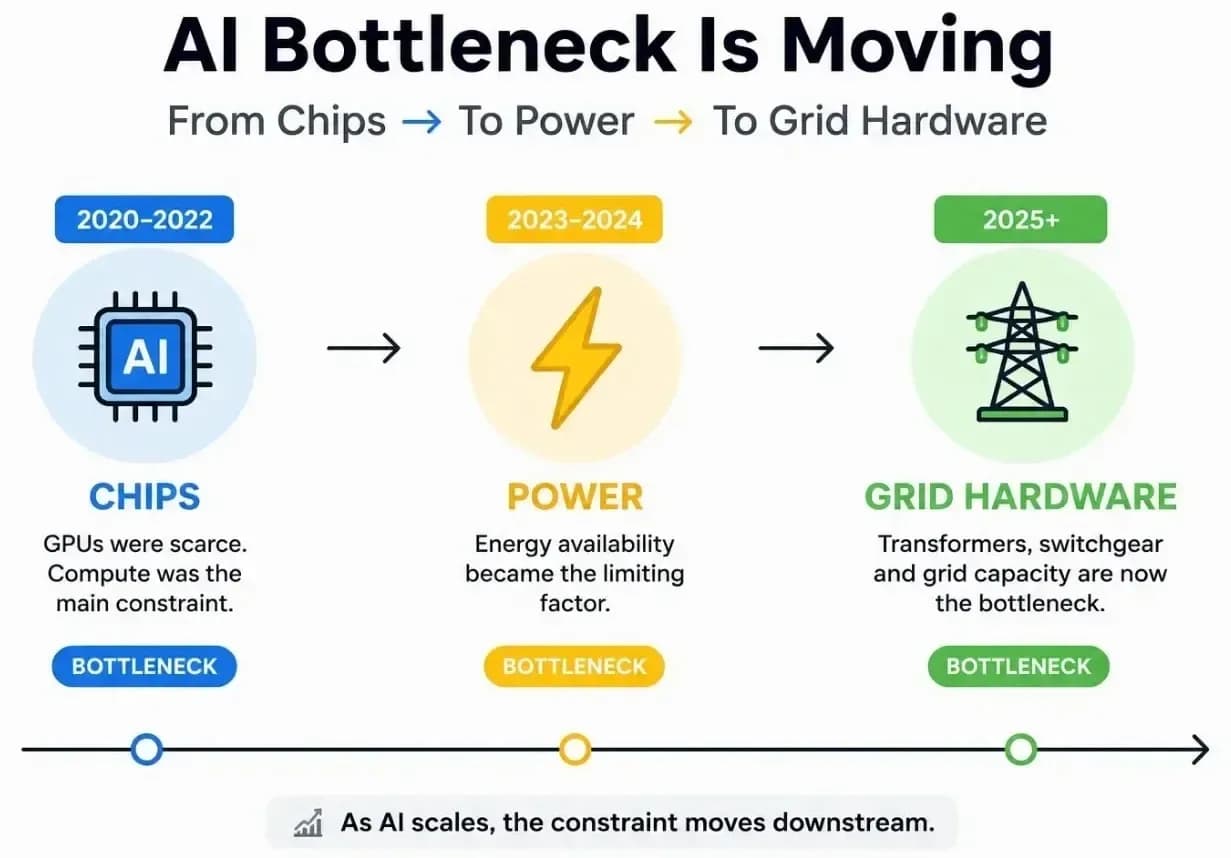
That era has quietly ended. Chip supply has now materially eased. It is no longer the main constraint choking AI growth the way it once did. This shift barely made headlines when it happened.
A shortage ending is simply less dramatic than a shortage beginning, so most coverage moved on without noticing. But this matters a great deal. For years, chips were the single number everyone tracked.
GPU counts, wait times, allocation deals. Once that pressure eased, it left a gap in the story. If chips are no longer the bottleneck, something else has clearly taken their place.
That something else is power. And unlike a chip shortage, a power shortage cannot be solved by simply placing a bigger order.
The Power Problem Everyone Is Now Writing About
Power has become the real limit on AI growth. Global data center electricity demand is expected to cross 1,000 terawatt hours in 2026. That is double what it was in 2023. This is not a small jump. It reflects how much electricity AI training and AI usage now consume, every single day.
Site selection for new data centers has changed because of this. Companies used to pick locations based on internet speed and fiber access. Now they search for one thing first. Available megawatts. A location with poor grid capacity is useless, no matter how fast its internet connection is. Engineering leaders from major cloud companies have said the same thing publicly. Power availability, not compute, is emerging as the true limiting factor for AI infrastructure. This is now the mainstream AI infrastructure story. But it is still not the full picture.
Also Read | AI in Public Services: Can Bharat Build Citizen-Centric AI at Scale?
The Money Gap Nobody Is Charting Clearly
The scale of spending here is genuinely hard to grasp. The world's largest technology companies have committed between 660 billion and 725 billion dollars to AI infrastructure in 2026 alone. That is nearly double what they spent the year before.
Yet the physical buildout is running far behind that financial commitment. And the gap between money spent and capacity actually delivered keeps widening, not shrinking. This is the real contradiction at the heart of the AI infrastructure story. Huge capital is available. Physical capacity is not keeping pace with it.
Also Read | India's Sovereign AI Ambition Has A Hidden Weak Link, And It Is Not The Models
Industry estimates suggest that a large share of planned 2026 AI data center capacity may slip to 2028 instead. That delay comes directly from power grid connection queues and construction bottlenecks, not from lack of funding.
Money alone cannot fix a grid interconnection queue or train new electricians overnight. Separately, Gartner projects that a large share of AI data centers will become power constrained within the next year or two. Put these two numbers together and a clear pattern appears. The industry is not short on ambition or capital. It is short on physical delivery capacity.
Why Inference Quietly Costs More Than Training
There is a hidden cost most readers never think about. Training an AI model and running it for users are two very different power stories. Training is a bounded job. It ends once a fixed amount of computing time is used. Running a model for everyday use, called inference, never really stops. Every single chat message, every API call, every prediction request draws power in real time. This adds up fast, and it never pauses the way training does.
Industry estimates suggest inference will account for roughly three quarters of total AI energy consumption by 2030, as the number of deployed models keeps multiplying. In simple terms, the electricity bill for AI does not end when training finishes. It continues every single time someone uses the tool. This detail matters because most public conversation focuses on training costs, the dramatic, headline friendly number. The quieter, ongoing cost of inference is actually set to dominate total energy use, and very few articles explain this distinction in plain language.
Also Read | Why Small Language Models Are Becoming India’s Smarter AI Bet?
How Companies Are Responding
Faced with this pressure, large tech companies are acting less like software firms and more like utility companies. Several major cloud providers have signed nuclear power agreements to guarantee steady electricity supply. Some are exploring small modular reactors, which can provide continuous, on-site power generation without depending on local grid connections.
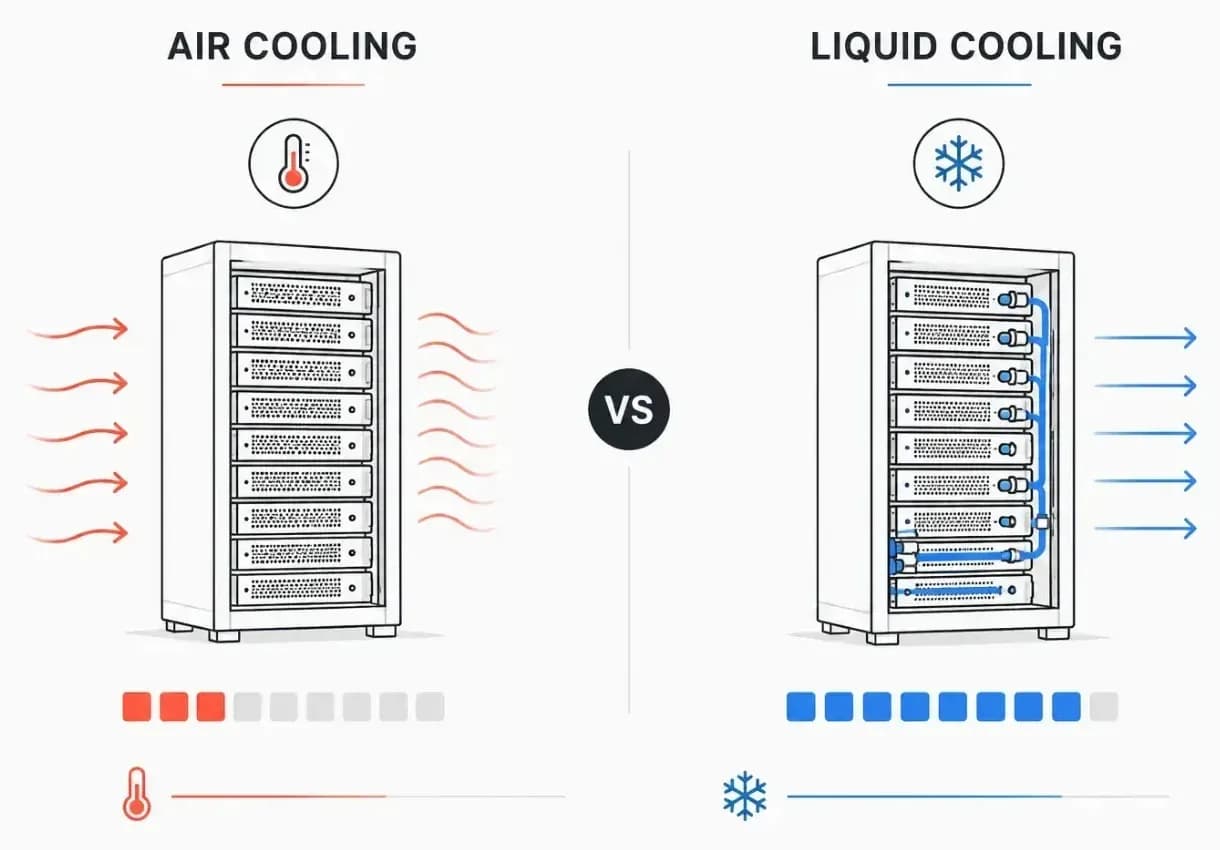
These projects are not quick fixes. They typically require five to ten year lead times, heavy regulatory approval, and enormous upfront capital. But they show how seriously companies are treating the power problem. Waiting years for a normal grid connection is no longer acceptable when AI demand keeps rising every quarter. Cooling has changed just as dramatically. Traditional air cooling stops working efficiently once a server rack crosses roughly 30 to 40 kilowatts of density. Many new AI server racks now exceed 100 kilowatts. That is simply beyond what air cooling can handle.
This is why liquid cooling has become central to modern AI data centers. It can dissipate much higher heat loads efficiently, replacing older air based cooling systems. Cooling used to be a background detail in data center design. It is now treated as a core engineering discipline of its own.
The Bigger Picture
Put all these pieces together and a clear pattern emerges. AI's bottleneck has moved from chips, to power, to grid hardware and labor, in less than three years. Each time one constraint eased, a deeper one appeared underneath it. This matters for anyone trying to understand where AI is actually headed. Model releases will keep grabbing headlines. But the companies that win the next phase of AI competition will likely be the ones that solve power delivery and physical infrastructure first, not the ones with the flashiest new model.
For a country like India, this trend is worth watching closely too. As AI adoption grows across industries here, the same infrastructure questions, power availability, cooling costs, grid capacity, will eventually shape how fast AI tools can scale locally as well.
Also Read | India's Data Centre Boom: Why States Are Competing for Digital Infrastructure
News4Bharat POV
Artificial intelligence is often portrayed as a software revolution, but its next phase will be determined by the physical world. The companies and countries that secure reliable electricity, resilient power grids, advanced cooling systems, and scalable data centre infrastructure will be best positioned to lead the AI economy. In many ways, the future of AI will be shaped not only by researchers writing code, but also by engineers designing substations, utilities expanding power networks, and policymakers investing in long-term infrastructure. The race for AI leadership has quietly become a race to build the world's most resilient digital infrastructure.