

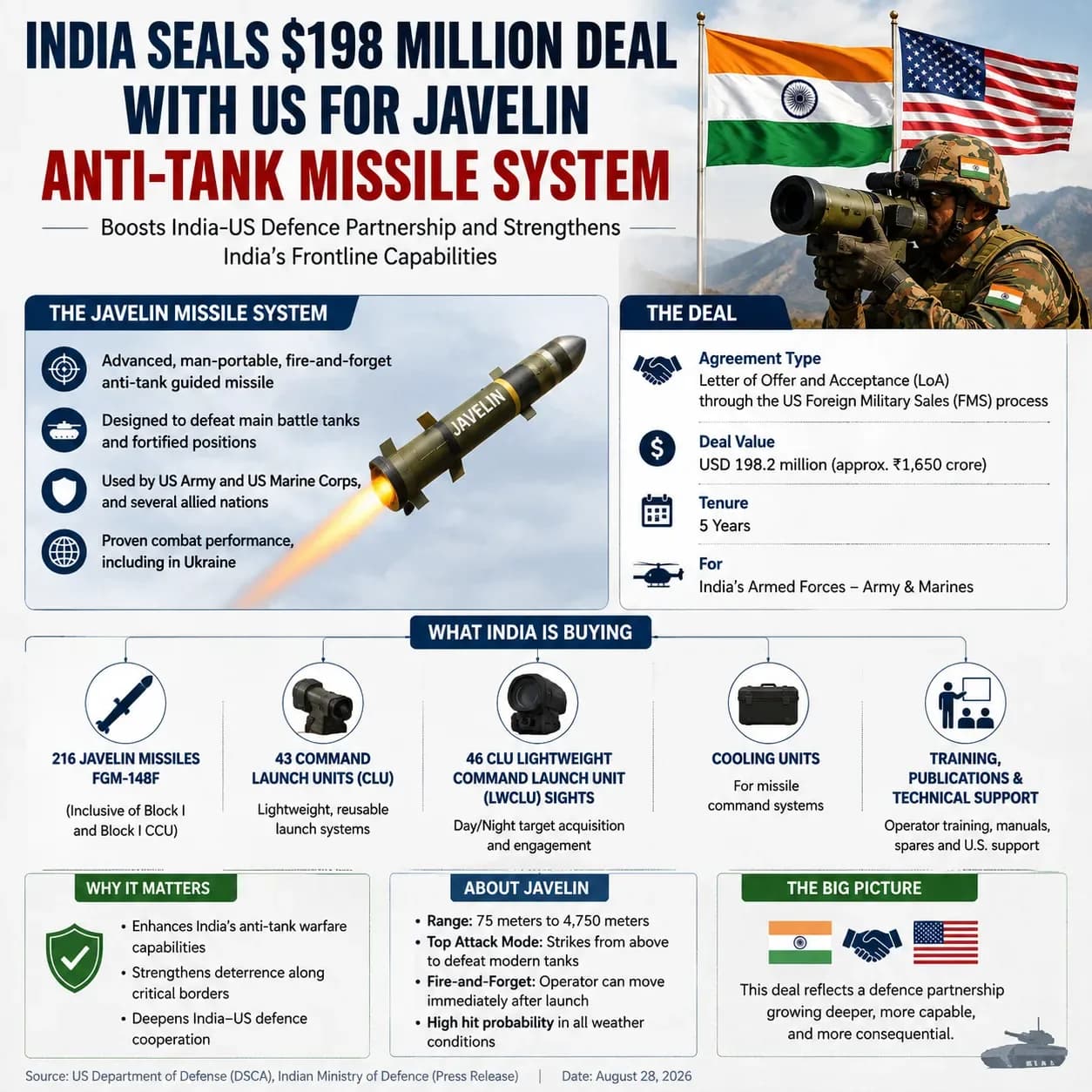
In a decisive move to modernize its frontline infantry capabilities, India has officially finalized an agreement to purchase the Javelin anti-tank missile system from the United States. The Indian Army completed the transaction by signing a formal Letter of Offer and Acceptance through the US Foreign Military Sales process.
The milestone acquisition represents a major qualitative leap for Indian ground forces. Washington warmly welcomed the development, noting that the agreement reflects a bilateral defense relationship that is expanding in scale, technical capability, and operational significance.
Understanding the Strategic Imperative Behind the Procurement
Modern land warfare demands rapid response capabilities against heavily protected armor formations. While modern armies field main battle tanks, infantry soldiers require agile, portable weapons capable of neutralizing armored threats from concealed, distant positions.
Operational Realities Along the Border
Infantry units deployed across rugged, mountainous environments face unique logistical and operational challenges. Transporting heavy, vehicle-mounted anti-tank systems across narrow mountain passes and steep ridges is often physically impossible.
The induction of lightweight, shoulder-fired guided missiles directly addresses this vulnerability. Giving small infantry squads the organic firepower to defeat main battle tanks at standoff distances fundamentally reshapes tactical defensive operations.
Bridging the Indigenous Development Timeline
India's Defense Research and Development Organisation has actively developed domestic systems, including the Nag missile and the Man-Portable Anti-Tank Guided Missile. While these indigenous programs continue to make solid technical progress, the operational necessity for immediate, combat-proven equipment led New Delhi to pursue interim foreign procurements.
By integrating the battle-tested Javelin into active infantry battalions, the armed forces maintain a high state of operational readiness while domestic manufacturing ecosystems continue to mature.
Decoding the Javelin System: How the Technology Works
The FGM-148 Javelin is widely recognized as one of the most effective anti-armor weapons in modern military arsenals. To understand why defense planners value this system so highly, it helps to examine its primary technical capabilities in everyday terms.
True Fire-and-Forget Guidance
Older anti-tank missile systems rely on semi-automatic command-to-line-of-sight guidance, which requires the gunner to keep their crosshairs pinned to the moving target until the missile impacts. On an active battlefield, remaining exposed for ten to twenty seconds leaves the soldier vulnerable to counter-fire.
The Javelin eliminates this hazard through an advanced imaging infrared seeker. The missile locks onto the target’s thermal signature prior to launch:
- The soldier locates the target through the thermal optics on the command launch unit.
- Once a lock is achieved, the trigger is pulled, and the missile self-navigates autonomously.
- The operator can instantly drop into cover or move to a new firing position before the missile hits.
Top-Attack Flight Trajectory
Modern tanks are built with exceptionally thick composite and reactive armor across their front glacis and side hulls. However, the top surface of a tank’s turret and engine deck remains relatively thin to keep overall vehicle weight manageable.
The Javelin exploits this structural reality using a dedicated top-attack flight mode:
- Upon launch, the missile climbs rapidly to an altitude of up to 150 meters.
- It tracks the target from above during the terminal phase of flight.
- The missile dives down vertically onto the roof of the tank, punching straight through the thinnest armor section with its tandem shaped-charge warhead.
Also Read | Lieutenant General NS Raja Subramani Named as India’s New Chief of Defence Staff
Soft-Launch Mechanism for Enclosed Spaces
Standard rocket-propelled weapons produce massive backblasts of flame and pressure that prevent operators from firing inside bunkers, rooms, or enclosed fortifications.
The Javelin employs a specialized two-stage motor. A small gas generator gently pushes the missile out of the launch tube before the primary rocket motor ignites several meters away from the operator. This soft-launch feature allows infantry teams to engage targets safely from inside buildings and covered defensive positions.
Details of the US-India Defense Transaction
The finalized purchase follows an earlier approval issued by the US Defense Security Cooperation Agency. That foreign military sales notification outlined a comprehensive tactical package designed for immediate integration:
- 100 FGM-148 Javelin rounds for operational inventory.
- 1 Javelin FGM-148 fly-to-buy test missile.
- 25 Javelin Lightweight Command Launch Units featuring enhanced thermal observation sights.
- Missile simulation rounds, basic skills trainers, and comprehensive maintenance support.
- An overall estimated transaction value of $45.7 million.
- The equipment is manufactured directly by the Javelin Joint Venture, a collaborative defense partnership between RTX and Lockheed Martin.
Moving from Off-the-Shelf Buyer to Co-Production Partner
The signing of the Letter of Offer and Acceptance is more than a standard commercial transaction. It sets the foundation for deeper industrial co-development between New Delhi and Washington.
US Ambassador Sergio Gor emphasized that the agreement illustrates the expanding depth of US support for the Indian Army, noting that the strategic partnership between both nations is operating at record highs.
The Push for Localized Munitions Manufacturing
Historically, bilateral talks regarding Javelin transfers encountered hurdles over the sharing of proprietary infrared seeker technology. However, shifting geopolitical priorities have paved the way for unprecedented technology sharing.
US Defense Secretary Pete Hegseth reaffirmed Washington's commitment to pursue joint co-production of Javelin munitions directly inside India. Developing domestic assembly and maintenance lines aligns closely with the Indian government's defense self-reliance objectives, transforming an off-the-shelf purchase into a long-term manufacturing partnership.
Expanding the US-India Defense Procurement Ecosystem
Over the past two decades, India has systematically diversified its defense acquisitions, establishing a multi-billion-dollar equipment pipeline with American defense contractors. Last October, both countries signed the framework for the US-India major defense partnership, creating institutional stability across joint initiatives.
The Javelin contract joins a comprehensive list of major bilateral procurements:
- MQ-9B Drones: In October 2024, India finalized a landmark deal to acquire 31 MQ-9B High Altitude Long Endurance unmanned aircraft to conduct long-range intelligence, surveillance, and reconnaissance across land and maritime borders.
- Precision Artillery: Procurement of 216 M982A1 Excalibur tactical precision-guided projectiles designed for high-accuracy strikes using M777 ultra-lightweight howitzers.
- Maritime Surveillance: Ongoing plans to purchase six additional Boeing P-8I long-range maritime patrol and anti-submarine warfare aircraft for the Indian Navy.
- Attack Helicopters: A $198.2 million support and sustainment package approved for the Indian military's fleet of AH-64E Apache attack helicopters.
- Anti-Submarine Aviation: A dedicated five-year support contract valued at Rs 7,995 crore to sustain the Indian Navy’s fleet of MH-60R Seahawk multi-mission helicopters.
The integration of the Javelin anti-tank missile gives the Indian Army a battle-tested, top-attack capability tailored for demanding terrain. Combined with the roadmap for bilateral co-production, the deal reinforces India's infantry posture while deepening institutional defense cooperation between New Delhi and Washington.