

Air India's reported US$1.5 billion equity request from Tata Sons and Singapore Airlines highlights widening financial losses, rising regional airspace disruptions, and growing political scrutiny in Singapore over state-backed investment risks.
Air India’s $1.5 Billion Capital Call: Testing Singapore Airlines’ Multi-Hub Ambition
The reported Air India funding request of approximately US$1.5 billion has brought the sheer scale and cost of India’s aviation overhaul into sharp focus. As the airline navigates widening operating deficits, geopolitical airspace constraints, and fleet modernization demands, primary owners Tata Sons and Singapore Airlines (SIA) face crucial capital allocation decisions.
Far from a routine corporate recapitalization, this development has sparked political debate in Singapore regarding state-linked investment risk, while simultaneously testing whether Singapore Airlines' strategic ambition to secure a dominant foothold in India’s surging aviation market can withstand a protracted, multi-year turnaround.
Financial Landscape: Escalating Losses and Shareholder Demands
Air India’s multi-billion-dollar restructuring programme, initiated following the Tata Group’s privatization acquisition in January 2022, has encountered deep financial friction.
Widening Group Deficits
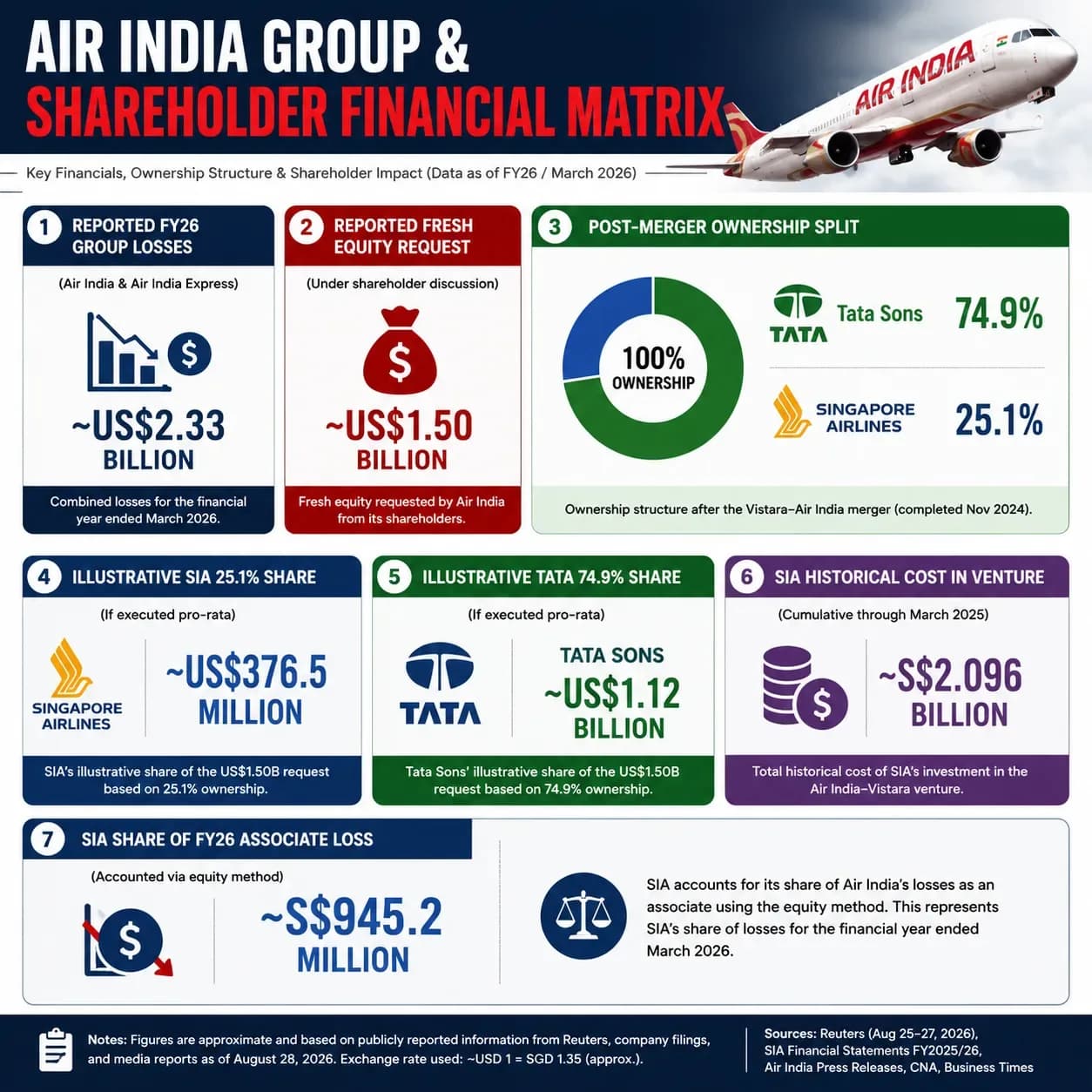
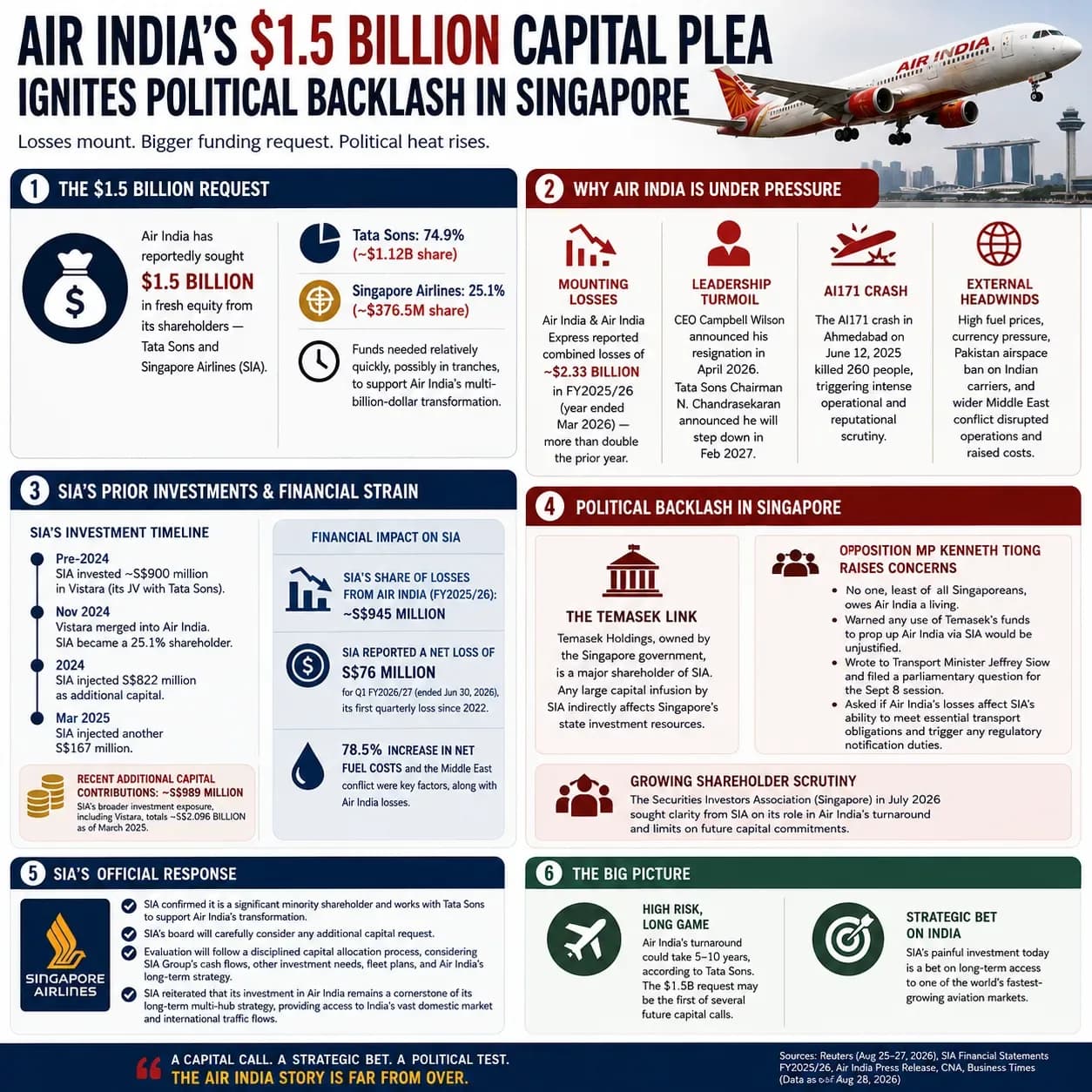
For the financial year ended March 2026, Air India and its low-cost subsidiary, Air India Express, recorded combined group losses of approximately US$2.33 billion. This figure represents more than double the prior year's consolidated deficit, driven by heavy capital expenditures in software migration, maintenance, cabin retrofits, and fleet leases.
Structure of the Capital Call
The airline has requested roughly US$1.5 billion in fresh equity to strengthen working capital and fund ongoing transformation milestones. While this injection provides vital liquidity, industry analysts note that the sum is smaller than the group's reported single-year deficit, indicating that further capital calls may be necessary before the carrier reaches operational cash break-even.
External Shocks and Corporate Leadership Transitions
The operational complexity of the restructuring has been compounded by severe regional disruptions and high-level management transitions across the parent organizations.
Airspace Restrictions and Jet Fuel Volatility
External operating conditions deteriorated substantially throughout 2025 and 2026:
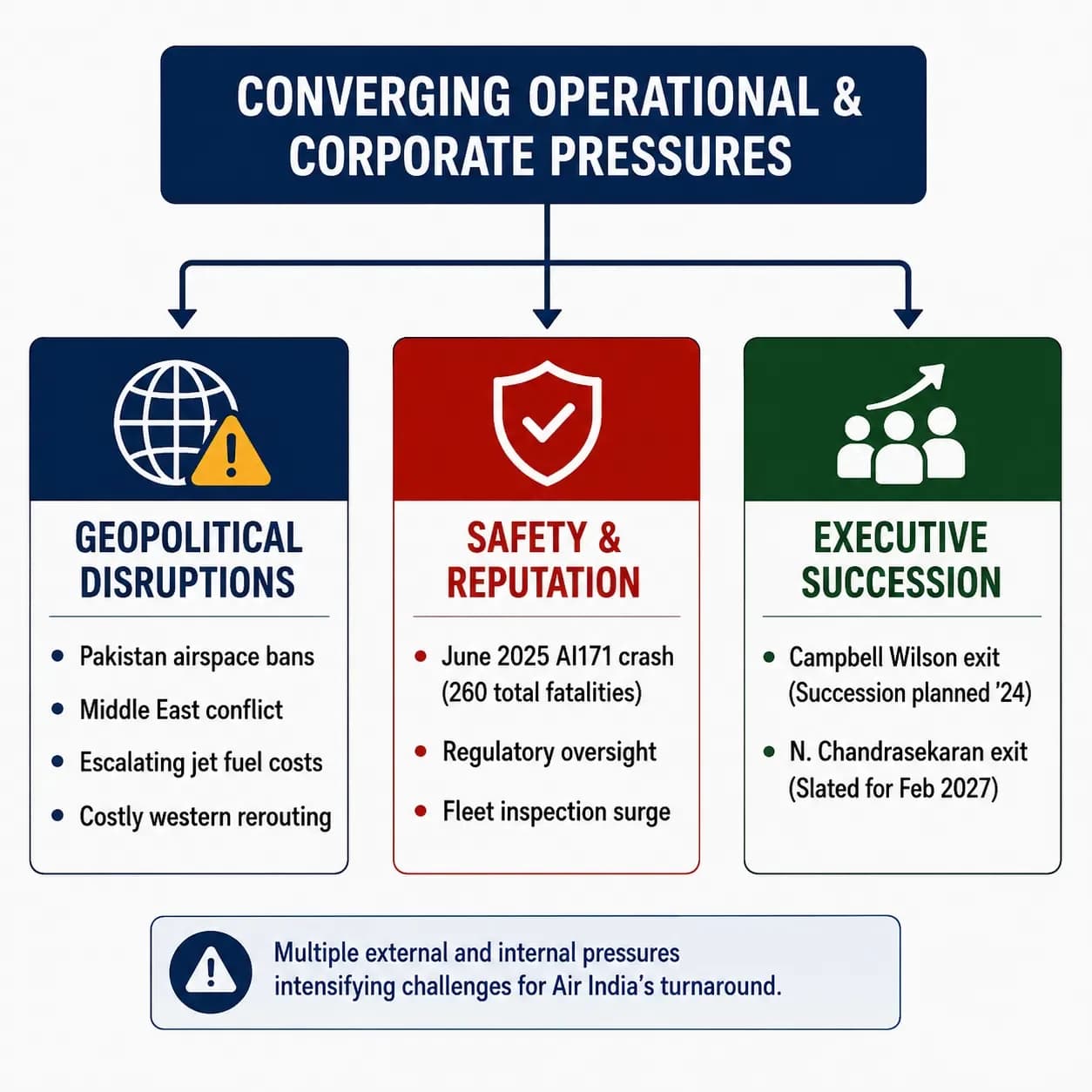
- Pakistan Airspace Closures: Prolonged restrictions on Pakistani airspace forced Indian carriers to reroute North American and European services via extended southern corridors, dramatically inflating block hours and fuel burn.
- Regional Conflict: The wider Middle East conflict involving the United States, Israel, and Iran severely disrupted key air corridors and drove regional jet fuel prices higher.
Operational Repercussions of Flight AI171
Air India continues to manage the intense operational, regulatory, and institutional aftermath of the tragic crash of Flight AI171 shortly after departure from Ahmedabad on June 12, 2025, which claimed 260 lives (241 passengers and crew onboard, one survivor, and ground fatalities). The disaster accelerated comprehensive fleet maintenance audits and intensified regulatory scrutiny across all operating divisions.
Planned Executive Shifts
Corporate leadership is undergoing structured transitions:
- Campbell Wilson's Departure: Chief Executive Officer Campbell Wilson tendered his resignation in April 2026 after four years at the helm. While his exit coincided with mounting losses, corporate filings confirmed that Wilson had initiated succession discussions with the board as early as 2024.
- Tata Sons Chairmanship: Tata Sons Chairman N. Chandrasekaran announced in August 2026 that he will step down from the chairmanship in February 2027, amid broader governance restructuring within the Tata Trusts and parent ecosystem.
Impact on Singapore Airlines: Balance Sheet Exposure and Political Scrutiny
Singapore Airlines’ involvement in Indian aviation represents a multi-year economic commitment that predates the consolidated entity.
SIA's CAPITAL ACCUMULATION TIMELINE IN INDIA
│
2013–2023 ──► Invested ~S$900M into Vistara 49:51 Joint Venture with Tata Sons
│
Nov 2024 ──► Vistara Merged into Air India; SIA secures 25.1% enlarged stake
│
2024–2025 ──► Added ~S$822M merger cash + S$167M injection (Total ~S$989M)
│
Mar 2025 ──► Cumulative investment cost base reaches ~S$2.096 Billion
│
FY 2026 ──► SIA books ~S$945.2M share of associate loss from Air India
Accounting Treatment and Earnings Headwinds
SIA accounts for its 25.1% interest using the equity accounting method:
- For the financial year ended March 31, 2026, SIA recognized approximately S$945.2 million as its share of losses from Air India, bringing the carrying value of the investment to S$1.1346 billion.
- For the quarter ended June 30, 2026, Singapore Airlines reported a net loss of S$76 million—its first quarterly deficit since 2022—weighed down by a 78.5% rise in net fuel expenses and associate losses, despite achieving record group quarterly revenue.
Political and Shareholder Debate in Singapore
The scale of capital deployment prompted debate in Singapore:
- Parliamentary Scrutiny: Opposition Member of Parliament Kenneth Tiong submitted questions to Transport Minister Jeffrey Siow examining whether sustained Air India obligations could impact SIA's essential transport capabilities.
- Temasek Ownership Nuance: Critics highlighted the exposure of state-backed entities, as Napier Investments (29.55%) and Temasek Holdings directly (20.86%) hold substantial stakes in SIA. However, market analysts emphasize that SIA operates as an autonomous, publicly listed corporation utilizing internal cash flows and corporate debt, rather than direct state budgetary allocations.
- Investor Queries: The Securities Investors Association (Singapore) (SIAS) similarly requested clarity regarding the limits of future balance-sheet exposure to the turnaround.
The Strategic Imperative: Why SIA Remains Committed to a Multi-Hub Model
Despite having substantial balance-sheet friction, Singapore Airlines' leadership maintains that direct access to India's aviation market is indispensable to its long-term corporate viability.
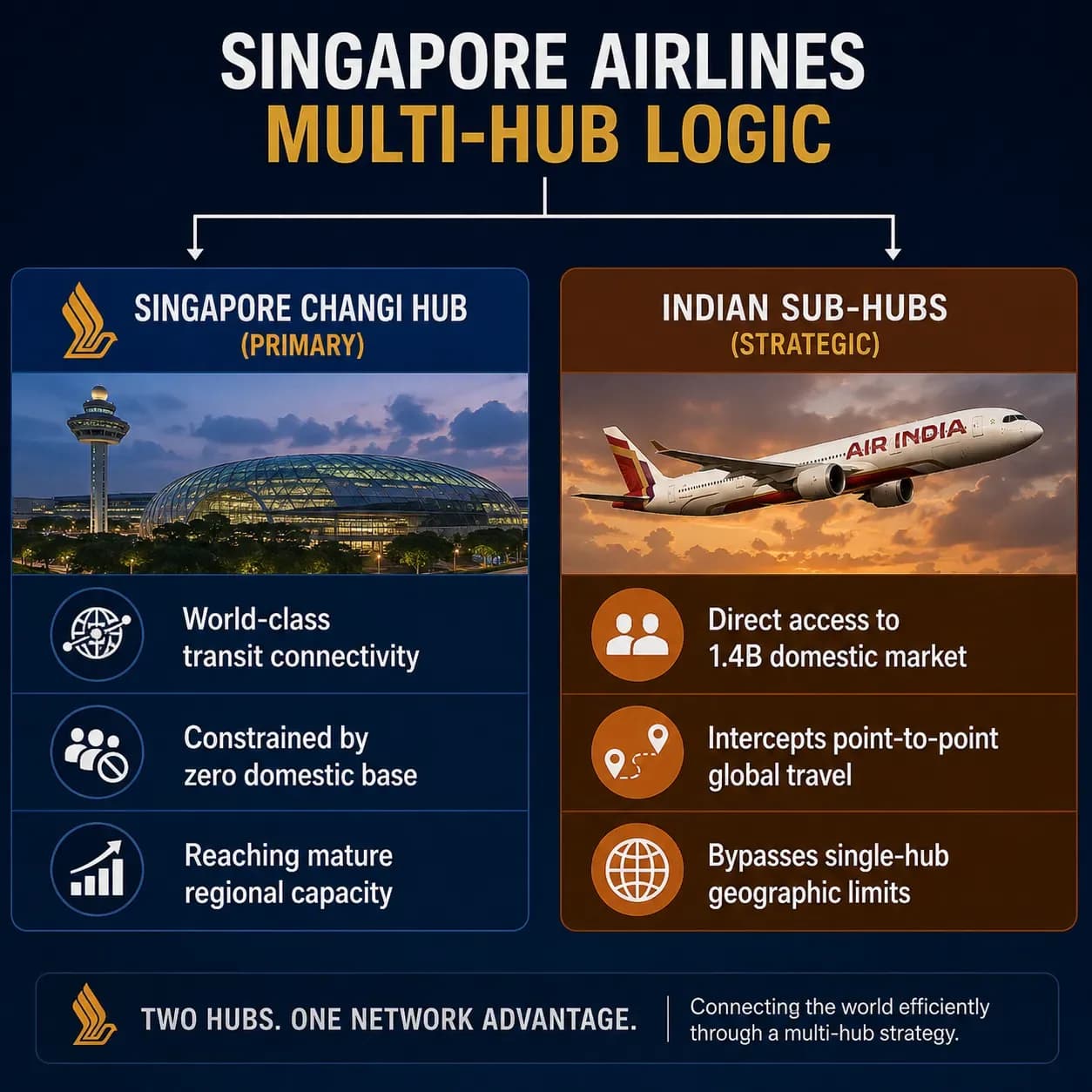
1. Overcoming Geographic Constraints: Singapore lacks a domestic aviation market. Establishing hubs in India allows SIA to capture high-density point-to-point traffic that bypasses Southeast Asia entirely.
2. Structural Growth: India represents one of the world's fastest-expanding aviation sectors, with massive outbound international travel demand.
3. Competitive Hedging: Direct equity participation prevents Gulf and North Asian megacarriers from monopolizing Indian long-haul transit corridors.
As Tata Sons and Singapore Airlines evaluate the US$1.5 billion recapitalization, the decision highlights the core reality of legacy aviation transformations: restoring Air India to operational and commercial self-sufficiency remains a long-duration capital commitment requiring years of patient execution.