Canada Confirms First Andes Hantavirus Case Linked to Cruise Ship Outbreak; Public Risk Remains Low
Canada Confirms First Andes Hantavirus Case linked to the MV Hondius cruise ship outbreak. Know symptoms, timeline, WHO update, public risk and key facts.
By News4Bharat | 2026-05-18T15:53:43.592352+05:30

Key Summary
- Canada has confirmed one case of Andes hantavirus linked to the MV Hondius cruise ship outbreak.
- The patient was among passengers who returned from the affected cruise ship and was tested by Canada’s National Microbiology Laboratory.
- Canadian authorities say the risk to the general public remains low, as all confirmed cases are linked to passengers or crew of the ship.
- The cruise ship outbreak has caused international concern because Andes hantavirus can rarely spread through close, prolonged human contact.
- Health officials are monitoring high-risk contacts, while WHO and national agencies are continuing the investigation.
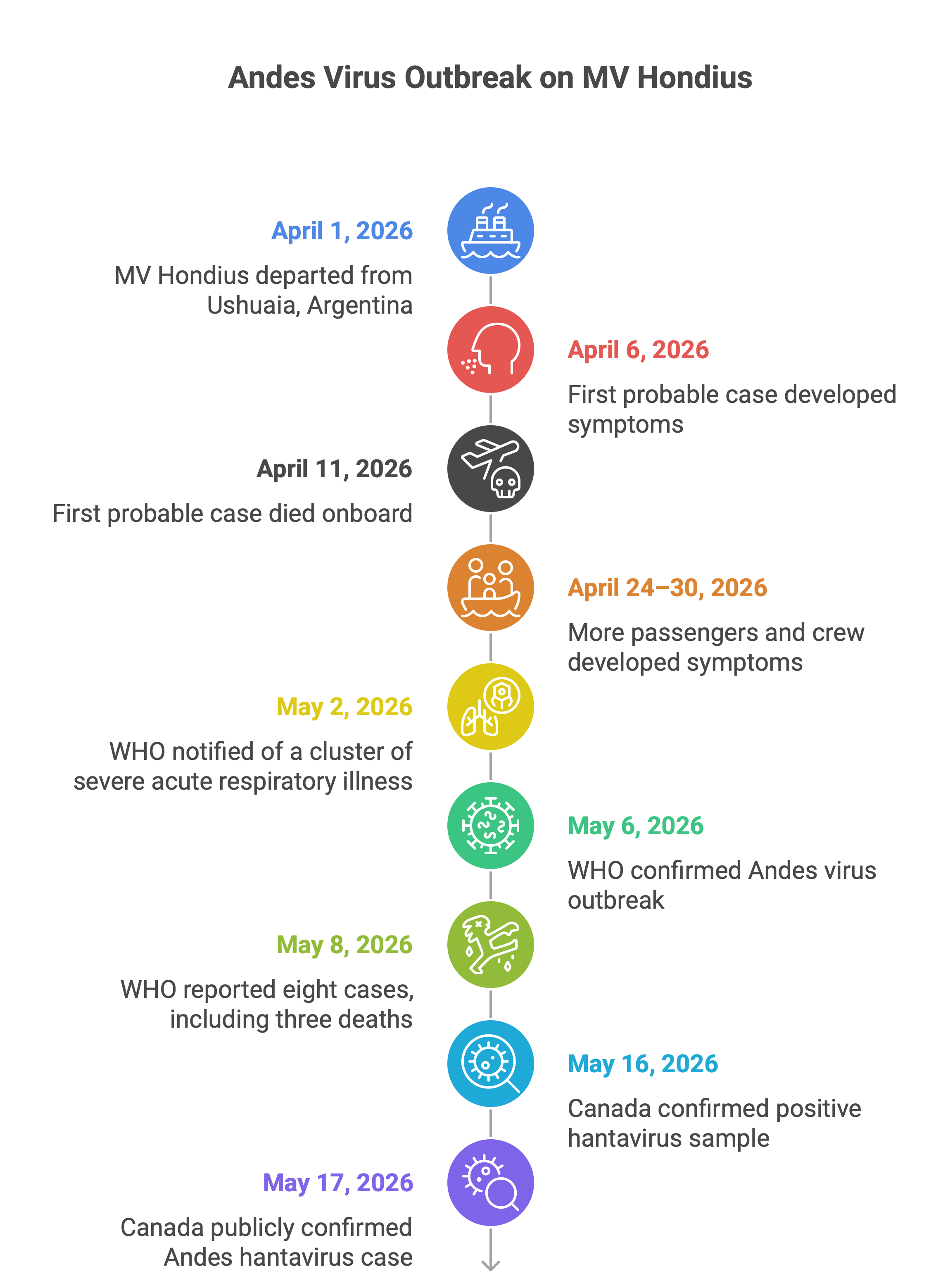
Canada has confirmed its first Andes hantavirus case connected to the MV Hondius cruise ship outbreak. The Public Health Agency of Canada said on May 17, 2026, that laboratory testing confirmed one positive case. The person was among passengers on the MV Hondius cruise ship, where an outbreak of Andes hantavirus has been under investigation by international health agencies.
Samples from British Columbia were sent to Canada’s National Microbiology Laboratory in Winnipeg, where one sample tested positive on May 16, 2026. A travelling partner of the confirmed case tested negative, and no further Canadian cases had been identified at the time of the official update.
Health officials have clarified an important point: this is not Canada’s first-ever hantavirus infection. Canada has recorded hantavirus cases earlier, mostly linked to rodent exposure. This latest case is different because it involves Andes hantavirus, a strain linked to South America and the ongoing cruise ship outbreak.
Canada says the general public risk remains low because all confirmed cases so far are linked to the MV Hondius passengers or crew, and high-risk contacts are in isolation and being monitored.
Also Read: A Rare Virus on a Cruise Ship Has Put Hantavirus Back in Focus. Here’s What It Means
Why This Matters to Bharat?
- Indian travellers must stay alert: Many Indians travel abroad for cruises, business, study and tourism. Any international outbreak linked to travel should be followed carefully.
- This is not a COVID-like situation: Health agencies say the general public risk is low. Hantavirus does not spread like common flu or COVID-19. Andes virus may spread only in limited situations involving close and prolonged contact.
- Rodent control matters in India too: Hantavirus is mainly linked to contact with infected rodents, their urine, droppings or saliva. In India’s villages, farms, warehouses, grain markets and urban slums, safe rodent control and cleaning practices are important.
- Health surveillance is important: The case shows why countries must quickly test, isolate, trace contacts and share information internationally.
- Do not panic, but do not ignore symptoms: People with recent travel history to affected areas or ships should monitor symptoms and contact health authorities if fever, body pain, stomach problems or breathing difficulty appear.
Explainer Box: Difficult Terms Made Simple
- Hantavirus: A group of viruses usually spread through contact with infected rodents, especially their urine, droppings or saliva.
- Andes hantavirus: A hantavirus strain mostly linked to South America. Unlike many other hantaviruses, it has shown rare human-to-human transmission in close and prolonged contact settings.
- Hantavirus Pulmonary Syndrome / Cardiopulmonary Syndrome: A serious illness where the lungs and heart can be affected. Symptoms may begin like fever and body pain, but can later lead to breathing difficulty.
- Incubation Period: The time between exposure to the virus and the appearance of symptoms. WHO says symptoms usually appear within 1–6 weeks, but can appear as late as eight weeks after exposure.
- Contact Tracing: A public health process where officials identify people who may have come in contact with an infected person and monitor them.
Canada’s Chief Public Health Officer Dr. Joss Reimer thanked public health authorities and frontline staff in British Columbia for managing the situation and said passengers’ cooperation with public health direction was helping keep others safe. PHAC also said it will continue monitoring the situation and supporting provincial and territorial health partners.
WHO has advised affected countries to continue contact tracing, monitoring, laboratory testing, case management, infection prevention and clear public communication. It also advised people linked to the affected ship and flights to monitor symptoms for 42 days after last possible exposure.
FAQs
What is the latest update on Canada’s hantavirus case?
Canada has confirmed one Andes hantavirus case linked to the MV Hondius cruise ship outbreak. The Public Health Agency of Canada says the general public risk remains low.
What is Andes hantavirus?
Andes hantavirus is a type of hantavirus found in South America. CDC says Andes virus has reportedly had person-to-person transmission, unlike most hantaviruses.
How does hantavirus spread?
Hantaviruses are usually spread through contact with infected rodents, especially their urine, droppings or saliva.
Is the Canada hantavirus case dangerous for the public?
Canadian health officials say the overall risk to the general population remains low in connection with the MV Hondius outbreak.
How many cases are linked to the MV Hondius outbreak?
WHO’s latest update reported 11 cases linked to the MV Hondius outbreak as of 13 May 2026.
Source URL: https://news4bharat.com/health/canada-andes-hantavirus-case-mv-hondius-cruise-ship-outbreak/