

In March 2026, crude prices jumped past 113 dollars a barrel during the West Asia crisis. By July, prices are moving around $100. That swing in just four months shows how fast an oil price shock in India can build and fade. If prices push toward levels that push petrol close to 100 rupees a litre again, the pattern will likely repeat, only sharper. This piece looks at how that kind of oil price shock in India actually moves through the economy, sector by sector, using real numbers from the last one.
How the Shock Travels Through the Economy
An oil price shock in India rarely stays in one place. It starts at the refinery gate and moves outward in stages. Crude oil gets refined into petrol, diesel and jet fuel. When crude costs more, refiners pay more. That cost moves to fuel retailers next. Diesel is the fuel that runs trucks, tractors and generators, so a diesel price rise touches almost every industry within weeks.
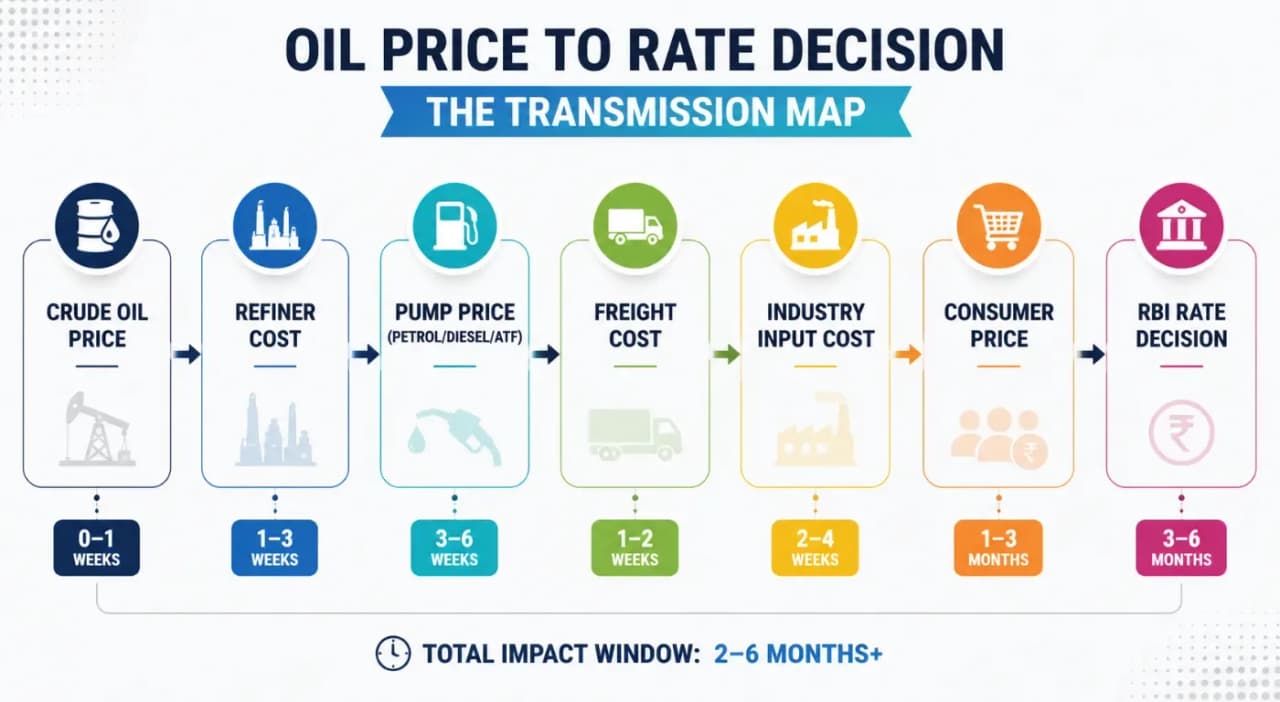
Aviation feels it almost overnight because jet fuel is priced and revised twice a month. Logistics and freight follow within two to three weeks. Consumer goods companies feel it later, usually six to eight weeks, once transport costs work their way into product pricing. This lag matters. It explains why airlines cut flights within days of a crude spike, while a packet of biscuits takes almost two months to get costlier.
Also Read | Rupee Gains as Oil Prices Slide on Hopes of U.S.-Iran Peace Deal
Ranking the Industries by Exposure
Not every industry gets hit the same way. Three things decide how badly a sector suffers during an oil price shock in India: how much fuel costs as a share of total expenses, whether the company can raise prices without losing customers, and how much it depends on imported raw material linked to crude.
Aviation sits at the top. Jet fuel has historically made up close to 40 percent of an airline's operating cost in India. During the March 2026 spike, global jet fuel prices surged close to 100 percent in four weeks, according to IATA data. Air India responded by cutting up to 22 percent of domestic flights between June and August 2026. IndiGo trimmed domestic capacity by 5 to 7 percent and international capacity by 17 percent. Logistics and road freight come next. Diesel is the single biggest cost for a trucking business. When diesel prices rise, freight rates rise within days, and that cost reaches every industry that ships goods by road.
Paints, tyres and plastics rely heavily on crude derivatives as raw material. These industries usually absorb the first hit on margins before raising product prices, since abrupt price hikes tend to hurt demand. Cement and fertilizers face higher transport and energy costs, but government subsidy support on fertilizers softens the direct hit on consumers, even if it adds pressure on the fiscal deficit. FMCG and agriculture feel the shock last but for the longest time, since diesel powers irrigation pumps, cold storage and last mile delivery across rural India.
Proof From the Last Shock
Numbers from the March 2026 episode confirm this pattern. Domestic ATF prices were raised by 25 percent in April 2026, taking rates to over 1,04,927 rupees per kilolitre in Delhi. The refinery margin on jet fuel, known as the crack spread, nearly tripled in three weeks, from 27.83 dollars to 81.44 dollars a barrel.
To limit the damage, the government capped the domestic ATF price hike at 25 percent and set up a 10,000 crore rupee price stabilisation fund for airlines. By July 1, 2026, as global tensions eased, ATF prices were cut by 5 rupees a litre, bringing relief to a sector that had been under pressure for months.
This is proof that an oil price shock in India is not permanent. It is cyclical, and it responds to both global events and government intervention.
Also Read | Airlines Are Flying at Loss With Every Takeoff. The Government Has Four Days to Read the SOS.
The Oil Story India Hasn't Fully Heard
Most coverage of an oil price shock in India stops at petrol pump prices and airline fares. Three things rarely get mentioned.
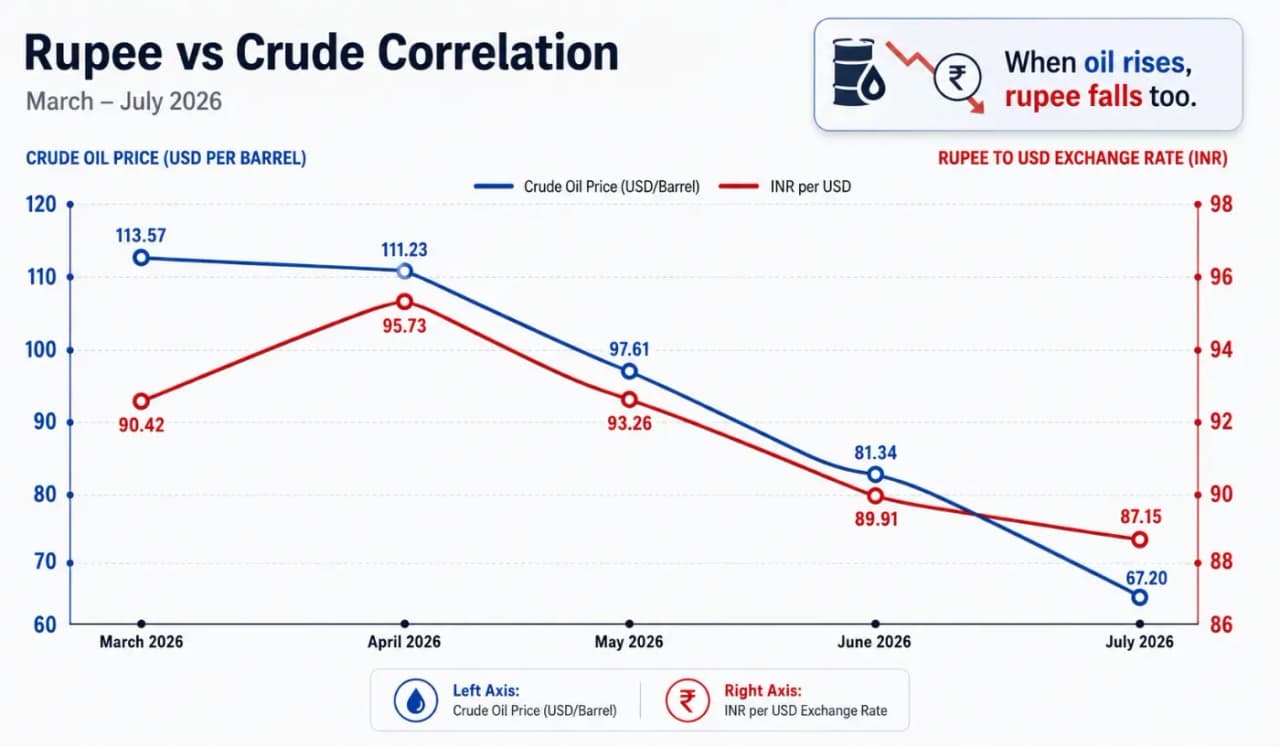
- First, the rupee connection gets underplayed. Oil is priced in dollars, so a price spike pushes up dollar demand. During the March 2026 spike, the rupee fell to a record low of 95.73 per dollar. A weaker rupee then makes every other import costlier, creating a second wave of price pressure that has nothing to do with oil directly.
- Second, the current account deficit angle rarely makes it into consumer facing articles. IDFC First Bank projected the CAD could widen to 1.7 percent of GDP if oil averaged 75 dollars a barrel, compared to a base case of 1.5 percent. ICRA pegged a similar scenario at 1.3 percent of GDP. This number eventually affects interest rates and loan EMIs, connecting an oil price shock in India directly to a household's monthly budget.
- Third, most reports miss the winners. Domestic oil exploration firms benefit when crude prices rise, since their revenue is tied to the same price that hurts refiners and consumers. Electric vehicle makers and renewable energy companies also gain an indirect edge, since a fuel price spike pushes more buyers to consider alternatives to petrol and diesel vehicles.
Also Read | Iran’s Hormuz Message Was Not Fired at One Ship. It Was Fired at the World’s Oil Route
What This Means for a Household
An oil price shock in India eventually reaches ordinary households through four channels. Fuel costs rise directly at the pump. Transport costs push up prices of daily goods. A weaker rupee adds pressure on anything imported, from electronics to edible oil. And if inflation runs high for long enough, interest rates tend to follow, raising EMIs on home and vehicle loans.
The March 2026 episode showed that this cycle can turn around within months once supply routes stabilise and government measures kick in. Petrol at 100 rupees a litre would not be permanent economic damage. It would be a stress test, one that India has already lived through once this year.