

Just seven months after publicly ruling out any plans to launch an airline, the Adani Group is once again at the centre of India's aviation conversation.
According to two people familiar with the discussions, the conglomerate is evaluating the possibility of entering the airline business, either by launching a new carrier or exploring other strategic options. The discussions remain preliminary and no final decision has been taken.
At first glance, this appears to be another chapter in Gautam Adani's expansion across infrastructure. Look a little closer, however, and the story becomes far more significant.
The idea did not begin as an internal expansion plan. According to Reuters, government officials quietly reached out to several large business groups after concerns grew over the increasing concentration of India's aviation market and the operational challenges faced by its two largest airlines. Adani was among the groups approached.
That changes the context entirely.
Why the Government Wants More Competition in Indian Aviation
Air India has faced heavy scrutiny since last year's crash. That scrutiny has not gone away. It has grown into a bigger worry. People are asking hard questions about its safety systems and its recovery.
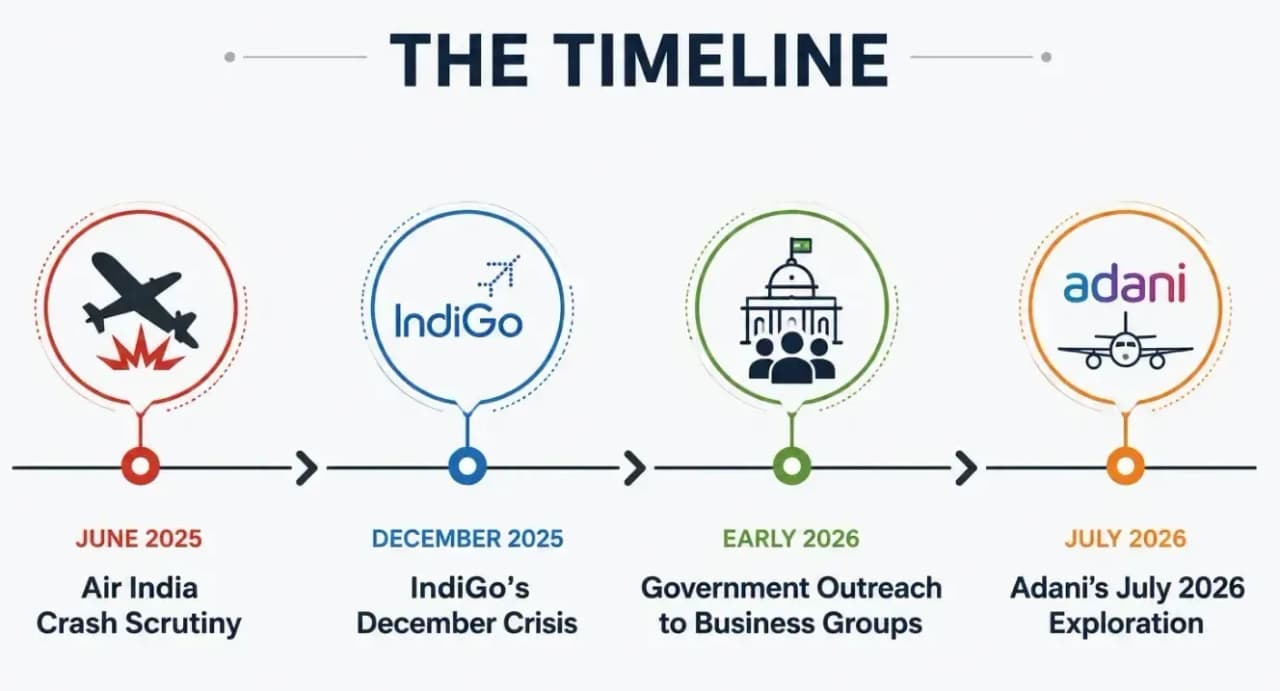
At the same time, IndiGo hit its own crisis. In December, the airline had major operational failures. Flights were delayed or cancelled across the country. Thousands of passengers got stuck. This mattered because IndiGo flies a huge share of India's daily flights. One bad month exposed a real risk. India was relying too much on two airlines. Both were struggling, just in different ways. That is when the government began quiet talks. It approached large business groups. Adani was one of them.
One source close to the matter said it clearly. Adani wants to help, in the national interest. Even though the airline business is hard. This line matters a lot. It shows this was never just about profit. It was about filling a real gap. A gap that affects every flyer in the country.
Also Read | Adani Group Wins Jaiprakash Associates Resolution Battle After NCLAT Dismisses Vedanta Appeal
Jeet Adani's December Remark Looks Different Today
During a public interaction in December 2025, Jeet Adani, Director of Adani Airport Holdings, was asked whether the group planned to enter the airline business.
His response was widely interpreted as a denial.
However, he also noted that nothing was permanently ruled out and that existing regulations prevented airport operators such as Adani from entering the airline business.
In hindsight, the remark appears less definitive than it initially seemed.
While it would be inaccurate to describe it as confirmation of future plans, it did indicate that regulatory restrictions—not necessarily strategic intent—were the primary obstacle.
The Bigger Question Isn't Adani. It's Market Fairness.
Whether Adani ultimately launches an airline is only one part of the story.
The larger policy debate centres on whether airport operators should also be allowed to own scheduled airlines.
Current regulations restrict operators of Delhi and Mumbai airports from holding more than a 10% stake in an airline, a safeguard designed to prevent conflicts of interest.
Critics argue that an airport operator running its own airline could influence access to gates, slots or ground-handling services in ways that disadvantage competitors.
Supporters, however, believe carefully designed safeguards could allow greater investment without compromising competition.
That debate—not simply Adani's plans—may ultimately determine the future structure of India's aviation market.
Also Read | Gautam Adani Becomes Richest Indian, Surpasses Mukesh Ambani in 2026; Check Detailed Billionaires List
The Adani Story
Most coverage this week treats this as only an Adani story. That misses a big part of it. The same rule change could help another company too. GMR Airports could also launch its own airline. GMR runs major airports, including Delhi, one of India's busiest hubs.

This changes the scale of the story. If the rule is relaxed, this is not about one company. It could open the door for two large players at once. Both Adani and GMR already control key infrastructure across the country. Giving both a path into airlines is very different from giving just one.
That is a much bigger shift than one group's business plan. It could reshape how airports and airlines work together across India. It could also change how future policy treats infrastructure companies entering new sectors. What starts as a single rule change for two firms may end up setting a pattern. Other airport operators could ask for the same treatment later.
For passengers, this raises a simple question. Will more competition come from serious new players, or will a few large groups end up controlling both runways and planes. That question deserves more attention than it has received so far.
The Market Math Behind This Move
IndiGo and Air India together control almost 90 percent of domestic flights. Both airlines lost money in the 2026 financial year due to higher fuel prices. A weak rupee added more pressure, since fuel costs are tied to the dollar. Global tensions also disrupted some routes and raised costs further.
A strong third player could ease this pressure. More competition usually means more choices. It can also mean fairer prices for passengers. But this is not simple to build. A new airline takes years to set up. Buying a struggling one brings its own risks. Aircraft delays from Airbus and Boeing make timing even harder right now.
Also Read | Airlines Are Flying at Loss With Every Takeoff. The Government Has Four Days to Read the SOS.
How This Fits Adani's Bigger Bet
This airline talk is not happening in isolation. It fits inside a much bigger plan. Adani Group is speeding up a 100 billion dollar investment plan. That plan was meant to run over ten years. Now it may happen in just five or six. Adani Airports runs the group's airport business. Reports say it may list separately on the stock market by March 2027. An airline would fit naturally into this larger plan. It adds one more piece to an already growing aviation business.
Seen this way, the airline idea makes sense. It is not a sudden decision. It looks like a natural next step. Scale, timing, and government pressure all point the same way.
Also Read | India Aircraft Leasing Summit 2.0: Key Announcements, GIFT City Plans and Aviation Finance Updates
What Happens Next
As of now, no formal proposal exists. These remain preliminary discussions, according to government sources close to the matter. The airport ownership rule still needs legal clearance and Cabinet approval before anything can move forward in practice.
Whether Adani eventually becomes India's third major airline, whether GMR moves first instead, or whether this entire idea stalls inside policy discussions, remains genuinely uncertain. But one thing is already clear from everything reported so far. What started as a quiet, conditional denial in December 2025 has turned into one of the most closely watched stories in Indian aviation today.