International Tea Day 2026: How India Turned Tea into Chai, Culture and Livelihood
International Tea Day 2026 will be observed on May 21 with the theme “Sustaining Tea, Supporting Communities.” Read India’s chai history, economy & culture.
By Srajan Agarwal | 2026-05-21T10:31:00+05:30

Key Summary
- Tea entered India’s modern commercial history through British colonial plantation expansion, especially in Assam in the 19th century.
- What began as an export-focused plantation crop slowly became India’s most common daily drink.
- Today, chai is not just a beverage; it is part of India’s home life, office culture, travel, small business economy and public conversation.
- India is now one of the world’s biggest tea producers, consumers and exporters, with Assam, West Bengal, Tamil Nadu and Kerala playing major roles.
- The story of tea matters because it connects colonial history, rural livelihoods, women workers, small growers, exports, climate risk and everyday Indian identity.
For millions of Indians, their day begins with chai. It is offered to guests, served at roadside stalls, carried in trains, shared during office breaks, and used as comfort during rain, stress, travel, celebration and tiredness. But this emotional connection did not happen overnight.
Tea, as a large commercial crop in India, grew under British colonial rule. The British wanted to reduce their dependence on Chinese tea and looked at Assam, as a plantation base.
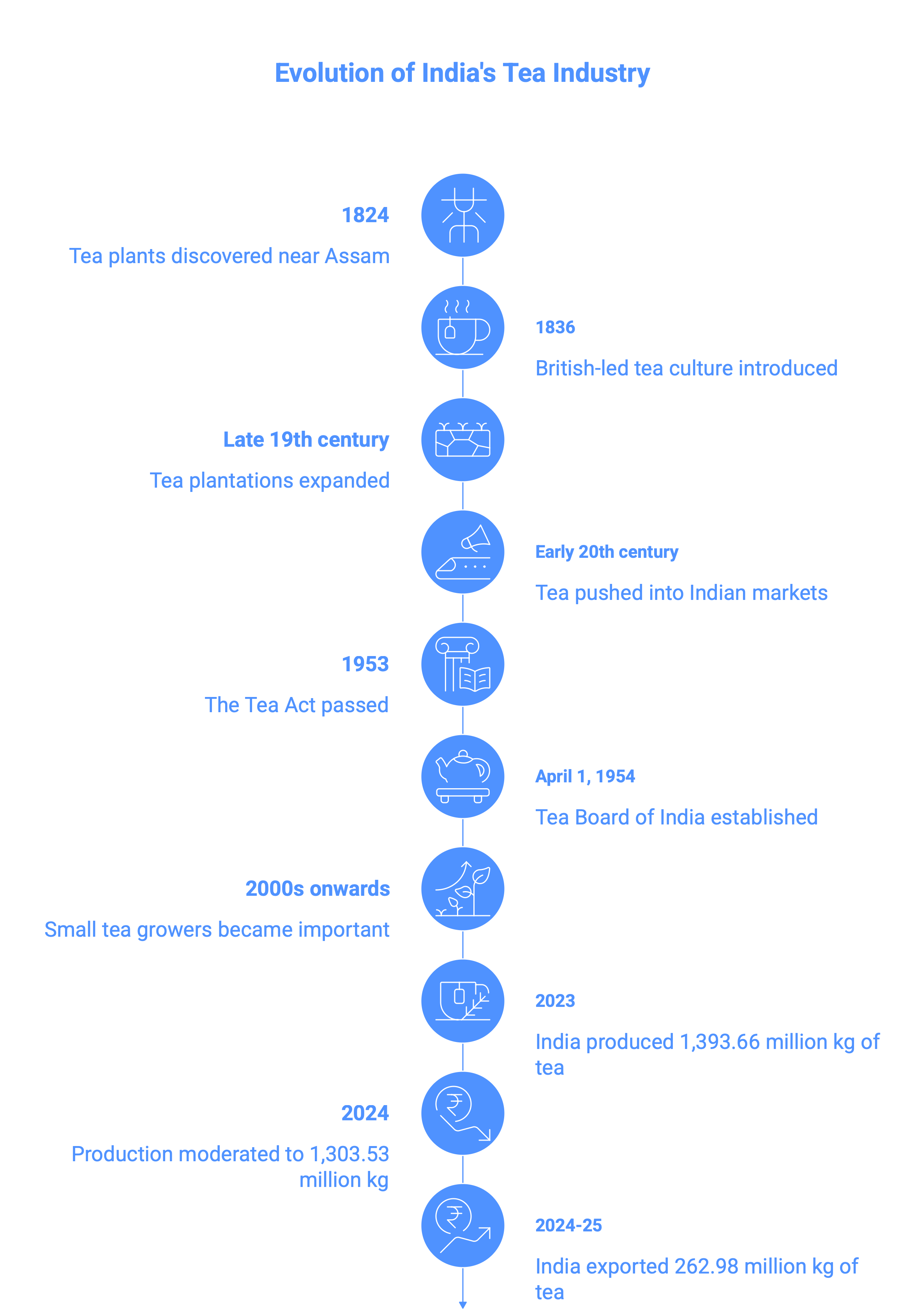
Tea plants were identified in the Assam region in the early 19th century, and British-led tea cultivation expanded from the 1830s onwards. Britannica notes that tea plants were discovered in the hills near Assam in 1824, and the British introduced tea culture into India in 1836. In the beginning, Indian tea was not grown mainly for Indians. It was produced for imperial trade, export markets and British consumption. Plantations needed land, labour, transport and a disciplined production system. This created a tea economy, but also raised difficult questions about labour conditions, land use and colonial extraction.
The big change came when tea moved from plantations and export markets into Indian homes and streets. Milk, sugar and basic indian spices made tea affordable, filling and familiar. Railway stations, factories, offices, colleges and bazaars helped spread chai as a social habit.
Over time, India did not just consume tea; it reshaped tea into chai. That is why the Indian cup is different. It carries history, economy, taste, class, memory and emotion together.
Also Read: Assam Startup Hub 2026: From Tea Gardens to Tech Revolution
Data Snapshot
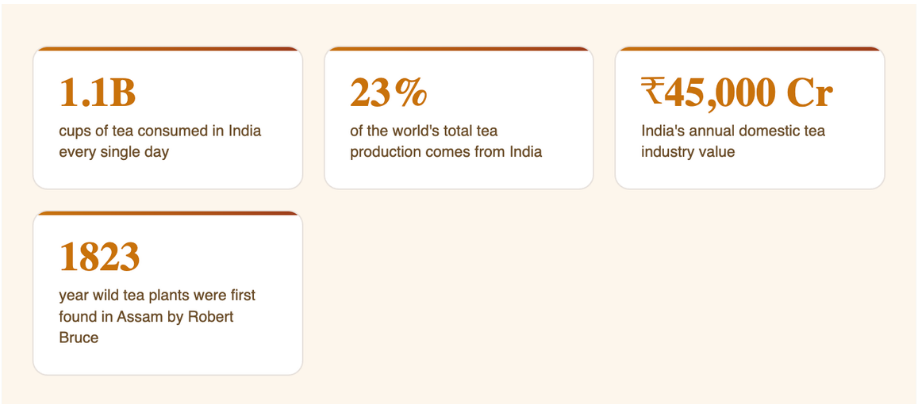
Why Tea Matters to Bharat?
- Tea is a livelihood issue: It supports lakhs of plantation workers, small tea growers, traders, transporters, packers, retailers and tea stall owners.
- It is a rural economy story: Tea is grown in states like Assam, West Bengal, Tamil Nadu, Kerala, Tripura, Himachal Pradesh, Uttarakhand, Bihar, Karnataka and several North Eastern states. PIB states that tea is grown in 15 Indian states.
- Women Workers POV: Nearly 58% of workers in the organised tea sector are women, according to PIB’s May 2026 explainer.
- A small grower story: Small tea growers now play a major role in raw leaf production and account for 52% of production, as per PIB.
- A climate story: Tea is sensitive to rainfall, temperature, pests and soil conditions. Climate stress can affect production, quality, worker health and prices.
- A consumer angle: Any change in tea prices affects household budgets, roadside vendors, hotels, rail travel vendors and small eateries.
- It is a cultural story: Chai has become a language of hospitality. In many Indian homes, “chai piyoge?” is not just a question; it is a welcome.
The Opium Connection Nobody Talks About
To understand how tea came to India, you need to understand the opium trade. This isn't a digression — it's the root of the whole story.
By the early 1800s, Britain was addicted to Chinese tea. China had no interest in British goods in return — the Emperor famously told King George III that China had "no need of your country's manufactures." The British balance of payments was haemorrhaging silver. So the East India Company devised an alternative: flood China with Indian opium.
Opium was grown in Bengal, traded illegally into China, and the proceeds used to buy tea. When China objected and confiscated opium shipments, Britain fought the Opium Wars (1839–1842 and 1856–1860) — the most explicitly narco-imperialist military campaigns in modern history. China lost both. Hong Kong was ceded. The opium trade was legalised.
But even as this drama unfolded, British officials were searching for a way to grow their own tea. Independent supply. No more Chinese leverage. And in the jungles of Assam, they found their answer.
Timeline of Tea in Bharat
- 1823 - Robert Bruce discovers wild Camellia sinensis var. assamica growing in Assam — a different variety from Chinese tea, but tea nonetheless. The British had not "brought" tea to India; it was already there.
- 1838- The first commercial shipment of Assam tea — twelve chests — arrives in London and is auctioned. The experiment is declared a success.
- 1840s–1880s - Tea plantations expand rapidly across Assam and Darjeeling. Adivasi and low-caste workers are recruited under contract labour — the "coolie system" — that closely resembles bonded labour. Conditions are brutal. Deaths are common. The British planter class grows rich.
- 1870 - India is now exporting 6.7 million pounds of tea annually. By 1890, it will overtake China as the world's largest tea exporter.
- 1901 - The Indian Tea Association begins an aggressive domestic marketing campaign — the most significant marketing effort in the subcontinent's history. Their mission: convince Indians to drink the tea being grown on their own soil.
- 1953: The Tea Act was passed.
- April 1, 1954: Tea Board of India was established under the Tea Act, 1953.
- 2000s onwards: Small tea growers became increasingly important in India’s tea supply chain.
- 2023: India produced 1,393.66 million kg of tea.
- 2024: Production moderated to 1,303.53 million kg.
- 2024-25: India exported 262.98 million kg of tea worth ₹7,817.58 crore.
- 2025: Production rose again to 1,369.98 million kg.
- 2026: Tea Board and government focus continues on quality, exports, worker welfare, small growers, traceability and climate resilience.
Context worth knowing
The Assam tea plantation system was built on what economists today call "unfree labour." Workers were transported from other states under the Workmen's Breach of Contract Act — which made leaving the plantation without permission a criminal offence. These conditions persisted, in various forms, well into the twentieth century and left a complex legacy in the communities of Assam and West Bengal that still work in tea.
The Versions of A Desi-Indian Chai

Impact on the Economy
Tea has a layered its impact on India’s economy at a very deeper level today. At the farm level, it provides regular employment in plantation regions and income for small growers. At the industry level, it supports manufacturing, auctions, packaging, blending, branding and exports. At the street level, tea is one of India’s most visible micro-enterprises, from small tapris to railway platform stalls.
According to PIB, India produced 1,369.98 million kg of tea in 2025, after 1,303.53 million kg in 2024 and 1,393.66 million kg in 2023. This shows the sector’s scale, but also its vulnerability to weather and market shocks. PIB also stated that India exported 262.98 million kg of tea worth ₹7,817.58 crore in 2024-25. That means tea is not just a daily drink; it is also a foreign exchange earner.
The economic concern is that tea is labour-intensive and climate-sensitive. If production falls, prices can rise. If auction prices remain weak, growers and estates may struggle to invest in replanting, worker welfare and quality improvement. If exports face competition from cheaper producers, India must protect quality, branding and traceability. The future of tea, therefore, depends not only on how much India grows, but how well it protects the people and regions behind every cup.
How Tea Became India’s Emotion
Bharat's Tea story has two sides. One side is colonial. The British expanded tea cultivation in India to challenge Chinese dominance and serve global trade. Assam became central because of its suitable climate and tea plant variety. Plantations were built around labour-intensive systems. This created jobs, but also deep social and economic inequalities.
The second side is Indianisation. India did not simply copy British tea culture. Indians changed tea. Instead of plain black tea, India made chai with milk, sugar, ginger, cardamom and local spices. The drink became cheaper, stronger and more filling. It suited Indian taste and climate. It also suited the rhythm of Indian life: morning homes, afternoon offices, late-night study sessions, bus stands, political addas, railway journeys and roadside shops.
The real turning point was access. Tea became available everywhere. A small vendor did not need a luxury setup to sell chai. A kettle, stove, milk, sugar, tea leaves and glasses were enough. This made tea part of the informal economy. Chai became the drink of workers, students, drivers, journalists, farmers, office-goers and families. Over generations, it moved from a colonial commodity to a people’s habit.
Today, tea is important again for a different reason. The sector faces climate change, price pressure, export competition, quality concerns, ageing bushes and labour welfare challenges. The cup of chai still feels simple, but the system behind it is complex.
The New Chai Economy
In the last decade, something interesting has happened to chai in India. It has been rediscovered by the urban middle class — not the cutting chai of the roadside stall, but a premium, nostalgic version sold in cafés with exposed brick walls and vintage tin signage. Chains like Chai Point, MBA Chai Wala, and Chaayos have raised millions in venture capital to serve the same beverage that a roadside stall makes for ₹10, but with free WiFi and the option to pay by UPI.
Critics call this gentrification. Enthusiasts call it scalable authenticity. The chai-wallahs who stand outside these cafés and charge one-fifth the price probably have the most nuanced view — somewhere between amusement and irritation.
What's undeniable is that chai's cultural power has made it extraordinarily marketable. It is perhaps the one food product in India that carries zero cultural controversy. You can argue about biryani (with or without potato? Kolkata or Hyderabad?). You can argue about coffee (filter coffee loyalists in the south will not yield an inch). But chai? Everybody drinks it. Everybody has an opinion on how it should be made. And somehow, all those opinions coexist.
News4Bharat Verdict
Tea’s journey in India is not a simple story of taste. It began as a colonial plantation product, entered trade routes, moved into Indian homes, changed its form with milk and spices, and became chai — a daily emotion across Bharat. But behind every cup is a serious economy of growers, workers, women, small vendors, exporters and climate-hit regions. The larger takeaway is clear: India must celebrate chai, but also protect the people and places that make it possible.
Summing it up
Tea came to India as an act of Empire. It was cultivated through exploitation, marketed through manipulation, and distributed through a system designed primarily to benefit British shareholders. None of that is contested history.
And yet. Within a century, Indians had taken this imposed commodity and done something extraordinary with it. They had reinvented it according to their own tastes, economics, and social needs. They had built around it a culture of hospitality, solidarity, and conversation that is entirely their own. They had made it democratic in a country where democracy has always been hard-fought.
That is the story of chai. Not a simple story of triumph over colonialism — history rarely works so cleanly. But a complicated, very human story of how people find meaning and community in the most unlikely places. Including a small glass of aggressively sweet, slightly burnt, perfectly imperfect tea.
This International Tea Day 2026, when you pick up your cup, you're not just drinking a beverage. You're participating in a two-hundred-year story of adaptation, resistance, labour, love, and the quietly radical act of making something that was never meant for you into something that defines you.
Chai pi lo. It'll help you think.
FAQs
When is International Tea Day 2026 celebrated?
International Tea Day 2026 will be celebrated on 21 May 2026. The day is observed globally to highlight the importance of tea, tea workers, small growers, sustainability and the role of tea in rural livelihoods.
What is the theme of International Tea Day 2026?
The theme of International Tea Day 2026 is “Sustaining Tea, Supporting Communities.” It focuses on sustainable tea production and the welfare of communities connected with the tea sector.
Why is International Tea Day celebrated?
International Tea Day is celebrated to recognise the cultural, economic and social importance of tea. It also draws attention to tea workers, small farmers, sustainable farming, fair trade and climate-related challenges faced by the tea industry.
Which state produces the most tea in India?
Assam is India’s largest tea-producing state. It is known for strong, bold and flavourful tea that is widely used for milk tea and chai.
What is the role of the Tea Board of India?
The Tea Board of India works under the Ministry of Commerce and Industry. It supports tea production, quality improvement, exports, research, promotion, worker welfare and development of India’s tea sector.
What are the major challenges facing India’s tea industry?
India’s tea industry faces challenges such as climate change, irregular rainfall, rising input costs, ageing tea bushes, price pressure, labour welfare concerns, export competition and quality control issues.
What is the connection between International Tea Day and sustainability?
International Tea Day highlights the need for sustainable tea cultivation. This includes protecting soil, using water responsibly, supporting workers, improving small grower incomes and reducing the impact of climate change on tea gardens.
Why is International Tea Day important for Bharat?
International Tea Day is important for Bharat because tea connects rural livelihoods, women workers, small farmers, exports, local businesses and everyday culture. It reminds people that every cup of chai has a larger story behind it.
Source URL: https://news4bharat.com/bharat-explainers/international-tea-day-2026-india-chai-story/