

A few years ago, ordering a packet of milk, a phone charger or groceries online and receiving it within minutes seemed like an expensive urban experiment.
Today, instant delivery has become a regular shopping habit for millions of Indian consumers. Groceries are only the beginning. Beauty products, electronics, home essentials, festive decorations and gifting products increasingly arrive through the same neighbourhood fulfilment networks.
But behind this convenience is one of India's most expensive and fiercely contested business battles.
Blinkit, Zepto and Swiggy Instamart are competing for customers, delivery capacity, product assortment, retail partnerships and ultimately profitability. Their strategies differ, their reported financial metrics are not always directly comparable, and their long-term business prospects depend on far more than app downloads.
The financial stakes have become enormous.
According to the October 2026 Redseer-Google quick-commerce report, India's quick-commerce market reached approximately $13 billion in FY2025–26. The report projects a possible $70–90 billion market by FY2030–31.
That upper-end projection represents nearly seven times the FY26 market size. It is a research forecast, not a guaranteed outcome.
Meanwhile, a 12 November 2026 report citing Datum Intelligence estimated that quick-commerce festive-season GMV increased about 60% year-on-year to ₹22,528 crore, capturing approximately 16% of online festive sales.
The sector is expanding. The difficult question is whether the businesses competing for that expansion will generate attractive and durable returns.
So, who will win India's quick-commerce war in 2027?
Based on the latest available disclosures, Blinkit enters the next year with the strongest combination of scale, order growth and adjusted operating profitability. Zepto remains a major challenger, while Instamart has substantial scope to improve but faces difficult economics.
However, market leadership today is not a guarantee of dominance tomorrow.
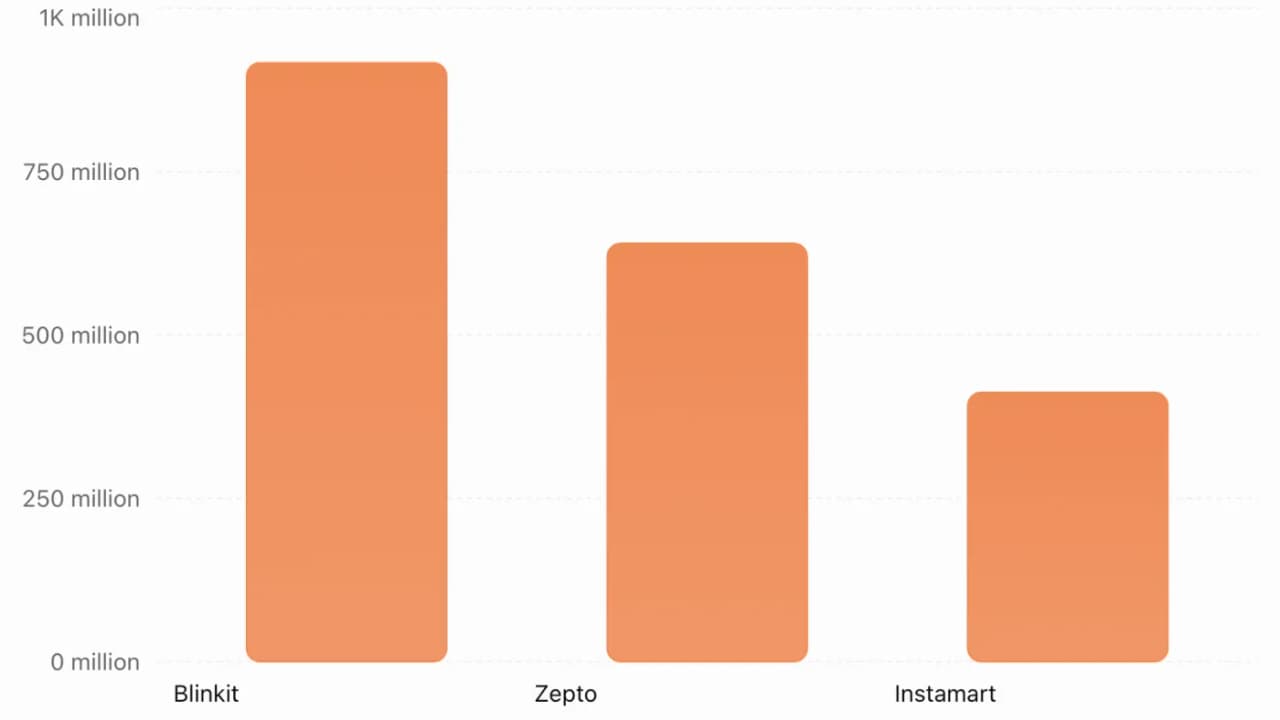
Who handled the most orders in FY2025–26?
1. Quick Commerce in India: How Big Is the Market?
Quick commerce is a retail model built around neighbourhood warehouses, commonly called dark stores, that fulfil online orders in minutes.
Unlike conventional e-commerce warehouses that serve large geographical regions, dark stores operate close to residential and commercial neighbourhoods.
Their proximity enables faster deliveries, but it creates additional operating costs involving real estate, labour, inventory, utilities and local logistics.
The Redseer-Google report released on 7 October 2026 identifies two important growth opportunities.
In metropolitan areas, platforms can expand beyond occasional purchases to larger household grocery baskets and non-grocery products.
Outside metros, they need to improve economics, customer trust, product availability and affordability.
The report estimates that metropolitan markets could contribute about 60% of incremental quick-commerce GMV over the longer-term forecast period, with non-metro markets contributing about 40%.
Another significant change is the widening range of products.
Quick commerce is no longer limited to emergency grocery purchases. Platforms increasingly compete with supermarkets, neighbourhood retailers and established online marketplaces.
News4Bharat has previously explored this shift in Quick vs Value Commerce: Who Will Win India in 2026?.
The next phase of growth may depend less on persuading people to try instant delivery and more on convincing them to purchase a greater portion of their regular household needs through these apps.
2. Blinkit vs Zepto vs Instamart: The Financial Scorecard
A meaningful comparison requires separating order volumes, order values, revenue and profitability.
These terms may sound similar, but they measure different aspects of the business.
FY26 order-volume comparison
| Indicator | Blinkit | Zepto | Swiggy Instamart |
|---|---|---|---|
| FY26 completed orders | 916.60 million | 640.18 million | 412.20 million |
| Share of these three platforms' orders | 46.6% | 32.5% | 20.9% |
| FY26 closing dark stores | 2,243 | 1,139 | 1,143 |
Source: Zepto's June 2026 updated IPO prospectus, which includes a peer comparison using company-reported figures.
The order shares are News4Bharat calculations using the three platforms' combined total of approximately 1.969 billion FY26 orders.
Also Read | The New Indian Middle Class: Digital Consumer Behaviour
3. Blinkit: The Market Leader Building a Scale Advantage
Blinkit, owned by Eternal Limited, enters 2027 as the clearest frontrunner.
In the July–September 2026 quarter, its net order value increased 79.3% year-on-year to ₹20,940 crore.
The platform processed approximately 398.9 million orders during the quarter, an average of more than 4.3 million orders per day.
Its dark-store network expanded to 2,751 locations after 308 net additions during the quarter.
Most importantly, Blinkit reported positive adjusted EBITDA of ₹184 crore, compared with a loss of ₹156 crore in the corresponding quarter a year earlier.
Its adjusted EBITDA margin reached approximately 0.9% of net order value.
This margin remains relatively thin, but it suggests the company is beginning to achieve a combination that competitors have struggled with: rapid expansion alongside improving adjusted operating profitability.
Why Blinkit Has an Advantage
The first advantage is network density.
A larger network can position inventory closer to customers, improve delivery coverage and potentially support higher order frequency.
The second is operational experience.
As stores mature, they have opportunities to improve inventory planning, supplier terms and order throughput while spreading fixed costs across more transactions.
The third advantage is access to capital within Eternal.
Eternal reported a consolidated closing cash balance of ₹16,475 crore for September 2026, although that balance belongs to the wider group and is not exclusively allocated to Blinkit.
4. Zepto: The Challenger With a Major Profitability Test
Zepto's rise has made it one of India's most closely watched consumer internet companies.
Founded by Aadit Palicha and Kaivalya Vohra, it helped establish instant delivery as a mainstream consumer proposition.
Its scale is substantial.
According to its updated draft red herring prospectus published in June 2026, Zepto processed approximately 640.18 million orders in FY26, compared with 332.11 million in FY25.
That represents growth of nearly 93% in average daily orders.
Revenue from operations rose from approximately ₹11,110 crore in FY25 to ₹22,624 crore in FY26.
But the profitability picture is more challenging.
Zepto reported a restated net loss of approximately ₹5,905 crore in FY26, compared with roughly ₹4,700 crore in FY25.
These are full-year accounting losses, not quarterly adjusted EBITDA losses, and should not be directly compared with Blinkit's September-quarter adjusted EBITDA figure.
5. Swiggy Instamart: A Large Platform Looking for Better Economics
Swiggy Instamart approaches the next stage of competition from a different position.
It benefits from its association with Swiggy's wider food-delivery ecosystem and an established consumer brand.
However, the latest financial disclosures indicate considerable pressure on quick-commerce profitability.
In Q2 FY27, Instamart reported gross order value of approximately ₹9,230 crore, up 31.4% year-on-year.
Its net order value grew 34.8% to ₹6,594 crore.
The company completed 130.3 million orders during the quarter, representing approximately 29.3% year-on-year growth.
The network reached 1,240 active dark stores across 133 cities at the end of September 2026.
Monthly transacting users increased to 14.8 million.
Nevertheless, Instamart reported an adjusted EBITDA loss of ₹895 crore for the quarter.
Swiggy's Different Strategy
Rather than relying only on price competition, Swiggy is increasingly emphasising differentiated product selection, product availability and customer retention.
Its October 2026 shareholder letter highlights initiatives including Switch, a brand-partnership programme; No!ce, its private brand; and Nectr, a curated fresh-produce offering.
Swiggy reported that No!ce appeared in approximately one in eight Instamart baskets.
It also discussed a transition towards greater inventory ownership, subject to the corporate and regulatory arrangements outlined in its disclosures.
Management estimated that the change could eventually deliver a net margin benefit of around 80 basis points.
That is a management expectation, not a realised improvement.
Estimated share of Indian quick-commerce orders, September 2026
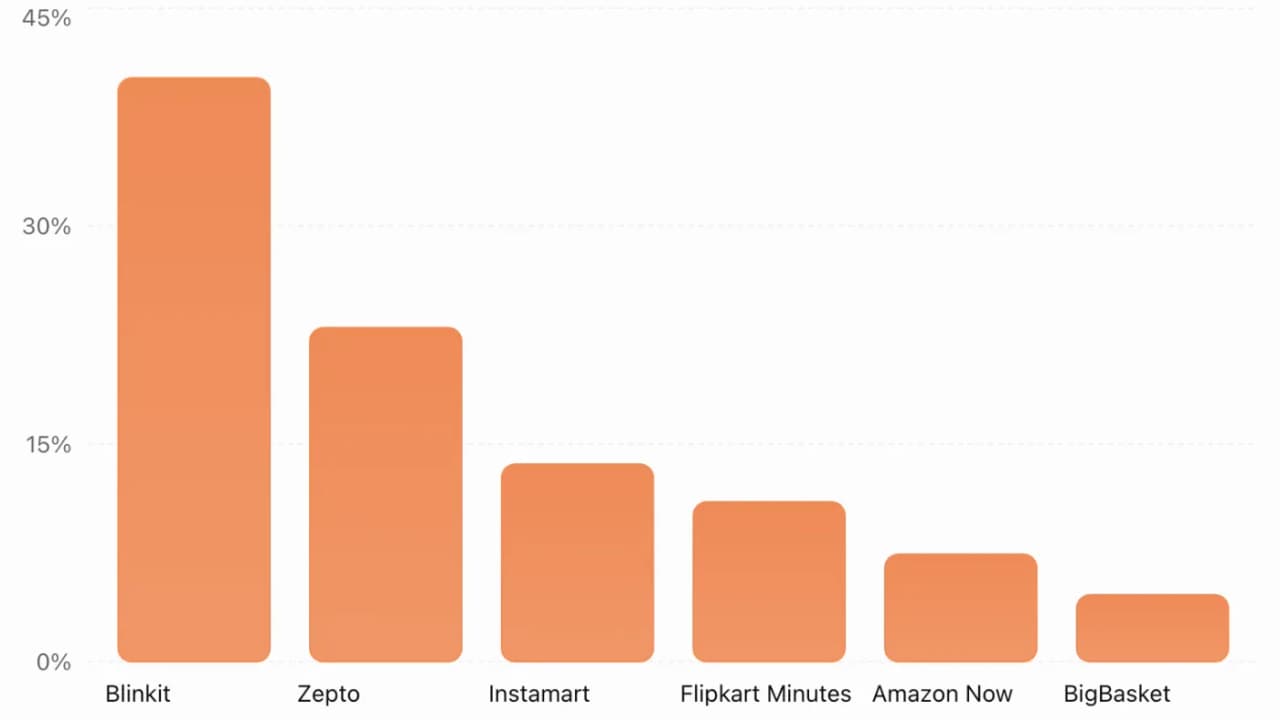 Source: Datum Intelligence estimates, reported by Mint on 23 October 2026. Figures are rounded and represent estimates across the covered platforms, not officially audited market shares.
Who Actually Leads Market Share?
Market share is one of the most misunderstood figures in the quick-commerce sector.
Reports may calculate it using completed orders, gross merchandise value, net order value, user activity or dark-store counts.
Each produces a different result.
According to Datum Intelligence figures reported by Mint in October 2026, Blinkit accounted for an estimated 40.2% of quick-commerce orders in September.
Zepto followed at approximately 23%, while Instamart held 13.6%.
Other platforms accounted for a meaningful share, including Flipkart Minutes, Amazon Now and BigBasket.
These figures tell a different story from an exclusive three-company comparison.
Blinkit remains the leader, but the competitive landscape is broader than three brands.
Meanwhile, an October 2026 CLSA analysis based on Sensor Tower data placed Blinkit's average weekly active users at approximately 36 million in Q2 FY27.
Zepto was reported as the second-largest standalone platform by this measure.
However, standalone-app activity is not a complete measure of Swiggy Instamart's audience because users may also access the service through Swiggy's primary app.
The implication is clear: no single market-share figure should determine the winner without examining how that share was calculated.
The Hidden Economics: Why Fast Delivery Is So Expensive
Quick-commerce profitability is not simply the difference between the selling price of groceries and the amount paid to suppliers.
Every transaction involves multiple costs.
Consider an illustrative ₹500 customer basket.
| Illustrative item | Amount |
|---|---|
| Customer purchase value | ₹500 |
| Assumed gross merchandise margin (15%) | ₹75 |
| Picking and packing cost | ₹12 |
| Last-mile delivery cost | ₹30 |
| Promotional discount funded by platform | ₹20 |
| Inventory shrinkage and wastage allowance | ₹8 |
| Allocated fixed operating expense | ₹25 |
| Illustrative contribution after listed expenses | −₹20 |
These are hypothetical assumptions created to explain the business model. They are not Blinkit, Zepto or Instamart's actual per-order costs.
The New Rivals: Amazon Now and Flipkart Minutes
The quick-commerce battle is no longer an exclusive contest between Blinkit, Zepto and Instamart.
Amazon Now, Flipkart Minutes and BigBasket represent additional competition, with their own retail relationships, technology infrastructure and access to customers.
According to Datum Intelligence's September 2026 estimates, Flipkart Minutes accounted for approximately 11% of quick-commerce orders, while Amazon Now held around 7.4%.
That combined presence is large enough to affect the growth opportunities of the established leaders.
Amazon and Flipkart can draw on their wider e-commerce capabilities, although those advantages do not guarantee success in highly localised instant delivery.
The economics of shipping an item from a regional warehouse differ significantly from maintaining neighbourhood inventory and fulfilling orders within minutes.
Competition may also intensify outside groceries, especially in beauty, electronics, household products and everyday fashion.
For 2027, a major risk to all three established quick-commerce platforms is that larger retail ecosystems improve their instant-delivery offerings without needing to replicate every part of the same business model.
News4Bharat 2027 Outlook: Three Possible Scenarios
Scenario A: Blinkit Extends Its Lead
Blinkit continues to expand stores while maintaining strong order growth and positive adjusted EBITDA.
Its mature locations support newer ones, inventory productivity improves and expansion into smaller cities generates sustainable demand.
Under these conditions, Blinkit would be the strongest candidate to remain the overall market leader through 2027.
What could undermine it? Excessive expansion costs, intensifying price competition or declining productivity in newer markets.
Scenario B: Zepto Narrows the Gap
Zepto secures sufficient capital, reduces cash consumption and improves financial performance while retaining its substantial order base.
If those improvements coincide with stronger order frequency and successful expansion, Zepto could become a more formidable challenger.
A successful future public listing might also improve its access to expansion capital.
What could undermine it? Continued losses, unfavourable financing terms or weaker consumer retention once promotional spending is reduced.
Scenario C: Instamart Delivers an Operational Turnaround
Instamart improves the profitability of existing dark stores, makes its differentiated assortment more valuable to consumers and benefits from operational improvements associated with its inventory strategy.
Its food-delivery ecosystem may help it attract customers across multiple purchase occasions.
What could undermine it? Persistent adjusted EBITDA losses, slower improvement in store productivity or continued competitive pressure from larger rivals.
All three scenarios remain conditional. None is a forecast that the described outcome will definitely occur.
Research Methodology and Disclosure
This analysis uses publicly available information reviewed through 13 November 2026, including Eternal's Q2 FY27 shareholder disclosures dated 21 October 2026, Swiggy's Q2 FY27 shareholder letter dated 22 October 2026, Zepto's updated IPO disclosures dated June 2026, the October 2026 Redseer-Google report, and dated third-party industry estimates.
FY26 order-volume comparisons use the financial year ended 31 March 2026. The newer Blinkit and Instamart financial results cover the quarter ended 30 September 2026. Zepto has not been assigned September-quarter financial metrics without an equivalent public disclosure.
Gross order value, net order value, net receivables value, revenue, adjusted EBITDA and net profit are not interchangeable. Company-specific definitions and changes in inventory accounting can significantly affect comparisons.
Market-share estimates are attributed to their research providers. Scenarios and the 2027 winner assessment represent News4Bharat editorial analysis, not confirmed future outcomes or investment advice.
Principal primary sources: Eternal Investor Relations | Swiggy Financial Results | Zepto Prospectus on SEBI | Zepto Corporate Announcements | Redseer-Google Quick-Commerce Report | Ministry of Labour and Employment.