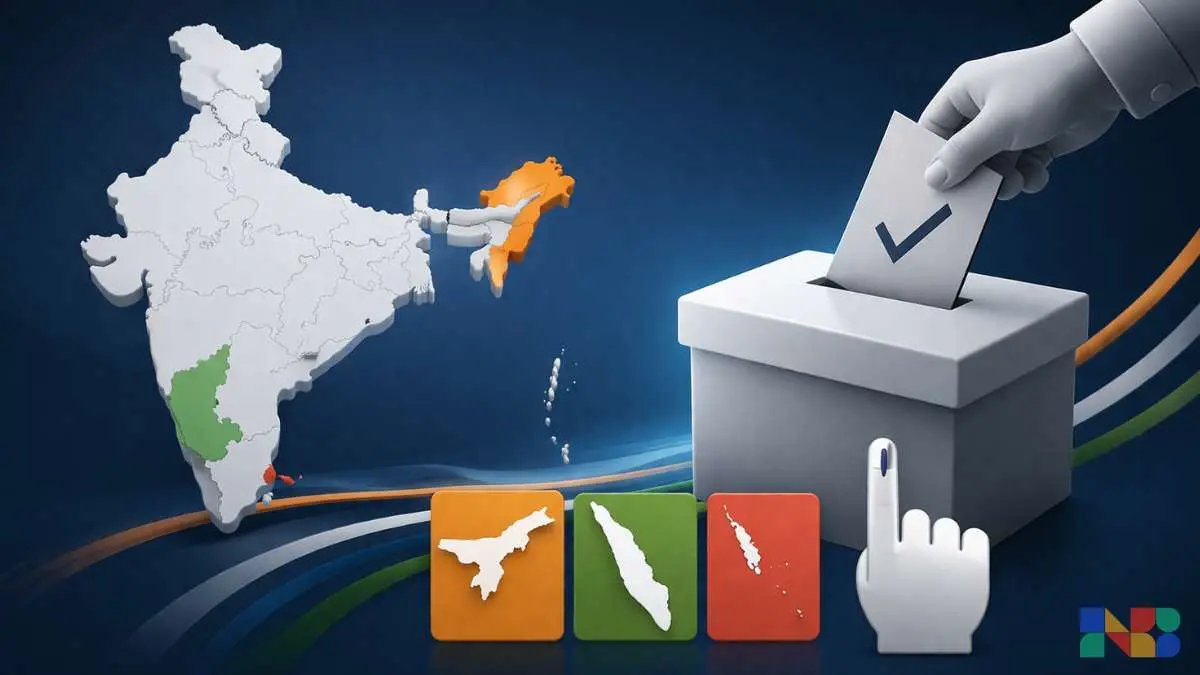
Three parts of India woke up to a different kind of morning on Thursday. No regular workday commute, no ordinary school rush. Instead, there were queues outside polling booths from 7 am onwards — some people arriving before sunrise, some standing in light rain in Assam, some in Thiruvananthapuram's early heat, and at least one newly married couple in Kerala's Pathanamthitta who drove straight from their wedding to cast their votes.
That last detail says something about how seriously Indians take this democratic exercise when it genuinely feels like it matters. And April 9, 2026 matters — for reasons that go well beyond the three regions voting today. The results, when they come on May 4, will tell both national parties where they stand ahead of the 2029 Lok Sabha elections.
Let's go through each state and territory in detail.
Also Read: Assam Votes Today: 2.49 Crore Voters, 126 Seats, and the BJP's Biggest Test in the Northeast
ASSAM: 126 Seats | 2.5 Crore Voters | BJP's Third-Term
Assam was, for most of independent India's history, Congress territory. The Congress ran the state for decades, with brief interruptions by the Janata Party and the Asom Gana Parishad. That changed in 2016, when the BJP-led National Democratic Alliance broke through for the first time — helped significantly by Himanta Biswa Sarma, who had left the Congress in 2015 after years of internal conflict with then-Chief Minister Tarun Gogoi.
In 2021, the BJP-NDA won again, this time with Sarma himself becoming Chief Minister. He has run the state with a firm hand since — tackling illegal immigration issues, taking on what he calls extremist elements, and projecting a strong nationalist development agenda.
Now he wants a third consecutive term. No party in modern Assam has managed three in a row.
Who's Fighting Whom
The ruling alliance has the BJP at its core, with partners including the Asom Gana Parishad (AGP) and United People's Party Liberal (UPPL). The opposition is led by Congress, working in a bloc that historically included AIUDF (All India United Democratic Front) but the formal alliance dynamics have shifted since 2021 when Congress distanced itself from AIUDF.
Raijor Dal, led by activist-politician Akhil Gogoi — who won from Sibsagar in 2021 from behind bars while facing sedition charges — is contesting independently and claiming to win by 50,000 votes this time. Smaller parties like the Assam Jatiya Parishad (AJP) are also in the field.
In total, 722 candidates are contesting across 126 constituencies for this election.
The Numbers Today?
As of 11 am on April 9, Assam recorded the highest early turnout among the three regions — approximately 38.92% by that hour. By 1 pm, Assam led at 59.63%, suggesting a healthy voter turnout that could approach or exceed the 74% recorded in 2021.
The river island of Majuli recorded 20.03% turnout in just the first two hours — the highest in Assam. The Bodoland Territorial Region's Tamulpur recorded the lowest at 15.32% in the initial phase, with reports of minor incidents.
There were reports of some tension in Tamulpur, with the Bodoland Territorial Council chief Hagrama Mohilary demanding action against those responsible for reported polling day violence.
What CM Sarma Did This Morning?
Himanta Biswa Sarma started his Thursday with a prayer at the Kamakhya Devi temple in Guwahati, accompanied by his wife Riniki Bhuyan Sharma. He then went to cast his vote. "Each voice and vote matters in building a better Assam," he wrote on X. He is contesting from Jalukbari in Guwahati — his own seat, which he needs to win to remain Chief Minister regardless of the alliance's overall performance.
Congress president in Assam, Gaurav Gogoi (who contested from Jorhat), said after casting his vote that "the people are voting for a new Assam."
What to Watch on May 4
For the BJP, the key question is whether its consolidation of votes in the tribal belts (through the UPPL alliance) and its development record holds. For Congress, the question is whether it can capitalise on anti-incumbency — particularly on issues like price rise, unemployment among youth, and questions about the NRC (National Register of Citizens) process.
The 52-week election cycle and Sarma's national profile mean that a comfortable third-term victory would significantly elevate him as a figure within the BJP nationally.
KERALA (KERALAM): 140 Seats | 2.69 Crore Voters | Three-Corner Battle
Kerala is one of India's most politically engaged states. Voter turnout here regularly crosses 70-75%. The state has historically alternated between two alliances — the CPM-led Left Democratic Front (LDF) and the Congress-led United Democratic Front (UDF) — roughly every five years.
In 2021, the LDF under Chief Minister Pinarayi Vijayan broke that pattern by winning again, securing 99 out of 140 seats. It was the first time since 1977 that a sitting government was re-elected in Kerala. Vijayan ran on his pandemic management record, his infrastructure push, and a narrative of stability.
Now, in 2026, Vijayan is 81 years old and remains the LDF's face. He is contesting from Dharmadam — the same constituency he has held for years. He kicked off his election campaign from there on March 17.
The LDF
The LDF's campaign slogan this time is "Mattarund LDF Allathe?" — which roughly translates to "Who else but LDF?" It released a 60-point programme promising a "Nava Kerala" (New Kerala), with 950 proposals spanning healthcare, education, women's welfare, senior citizens, and infrastructure. The manifesto includes an "Oommen Chandy Health Insurance" scheme offering ₹25 lakh coverage per household and free KSRTC bus travel for women.
The UDF
The Congress-led UDF's slogan is "Keralam Jayikkum, UDF Nayikkum" — "Kerala will win, UDF will lead." Its manifesto, released by Telangana Chief Minister Revanth Reddy, focuses on "Indira guarantees" — a set of welfare promises named after Indira Gandhi.
The BJP-NDA
The BJP in Kerala has been trying to establish a foothold in the state for years. Under state president Rajeev Chandrasekhar, the party organised a public interaction at CM Vijayan's home constituency in early March. PM Modi launched the BJP's official Kerala campaign from Kochi on March 11.
The BJP's slogan — "Marathathu Ini Marum" ("What never changed will change now") — targets the long-standing two-front pattern. The party is contesting all 140 seats and hoping to convert its 12.5% vote share from 2021 into actual seats this time.
Early Voting Trends
As of 11 am on April 9, Kerala registered 33.28% turnout — slightly behind Assam but tracking well for what is expected to be a 70%+ final turnout. By 1 pm, Kerala was at approximately 49.70%.
State Chief Electoral Officer Rathan U. Kelkar called the polling "very peaceful and very progressive." He noted strong participation including significant numbers of first-time voters from the 4.6 lakh newly registered electors.
One touching moment: a newly-wed couple from Pathanamthitta drove straight from their wedding ceremony to the polling booth to cast their votes. That image went viral.
A 62-year-old man named Vinodan collapsed and died at Vaniampara after standing in the queue for about an hour to vote. He had exercised his franchise before collapsing. It was a reminder of both the physical demands of voting and the commitment citizens bring to it.
What to Watch
Exit polls won't be published until after voting ends across all phases. But CPI(M) MP John Brittas said clearly on the day: "It is clear that the Left Front is going to come back to power." The UDF will point to fatigue after two terms. The BJP hopes its vote share in central and north Kerala has grown. May 4 will settle this.
PUDUCHERRY: 30 Seats | 9.44 Lakh Voters | Alliance Chess in a Small Theatre
Puducherry is a small Union Territory but its political dynamics are anything but simple. Three of India's eight Union Territories have legislative assemblies — Delhi, Jammu & Kashmir, and Puducherry. The central government also nominates three additional members to the 33-member legislature, giving the nominated bloc real leverage in hung assembly situations.
Since 2021, the territory has been governed by the All India N.R. Congress (AINRC)-led NDA coalition, with N. Rangaswamy as Chief Minister. His NDA won 16 of 30 elected seats in 2021. He is seeking another term.
Who's Standing Against Whom
The opposition this time is a Congress-DMK alliance, though the combine went through pre-poll drama. The Viduthalai Chiruthaigal Katchi (VCK) walked out of the alliance on March 24 over seat-sharing disagreements. CPI and CPI(M) also chose to contest independently in select constituencies.
The BJP is contesting as part of the NDA in Puducherry.
The Election Commission of India put a robot at a polling station in Puducherry to welcome voters — a detail the ECI's social media team cheerfully highlighted on the day.
Numbers So Far
By 11 am, Puducherry had 37.06% turnout. By 1 pm, it was at 56.83% — the highest proportional turnout at that hour among the three regions voting today. Puducherry typically records high turnouts given the small number of constituencies and the close community ties.
The territory's final registered voter count for 2026 is 9,44,211.
BY-POLLS: Gujarat, Karnataka, Maharashtra, Nagaland, Tripura
Alongside the three main assembly elections, by-elections are being held today in select constituencies across five states: Gujarat, Karnataka, Maharashtra, Nagaland, and Tripura.
As of 1 pm, some early turnout figures for by-poll constituencies:
- Davanagere South, Karnataka: 37.17%
- Bagalkot, Karnataka: 43.75%
- Koridang, Nagaland: 59.52%
- Dharmanagar, Tripura: 52.76%
Why This Election Season Matters Beyond State Politics
The 2026 assembly elections — today's batch, and Tamil Nadu and West Bengal voting April 23 and 29 — collectively elect 824 legislators across five legislative assemblies. Together they function as the largest political barometer India gets between Lok Sabha cycles.
For the BJP, holding Assam confirms its grip on Northeast India. Making meaningful gains in Kerala would signal a genuine national expansion story. For the Congress and INDIA bloc, Kerala is a must-win to demonstrate that the opposition narrative has traction outside Hindi-belt states.
The counting happens on May 4. That's when the dust settles.