
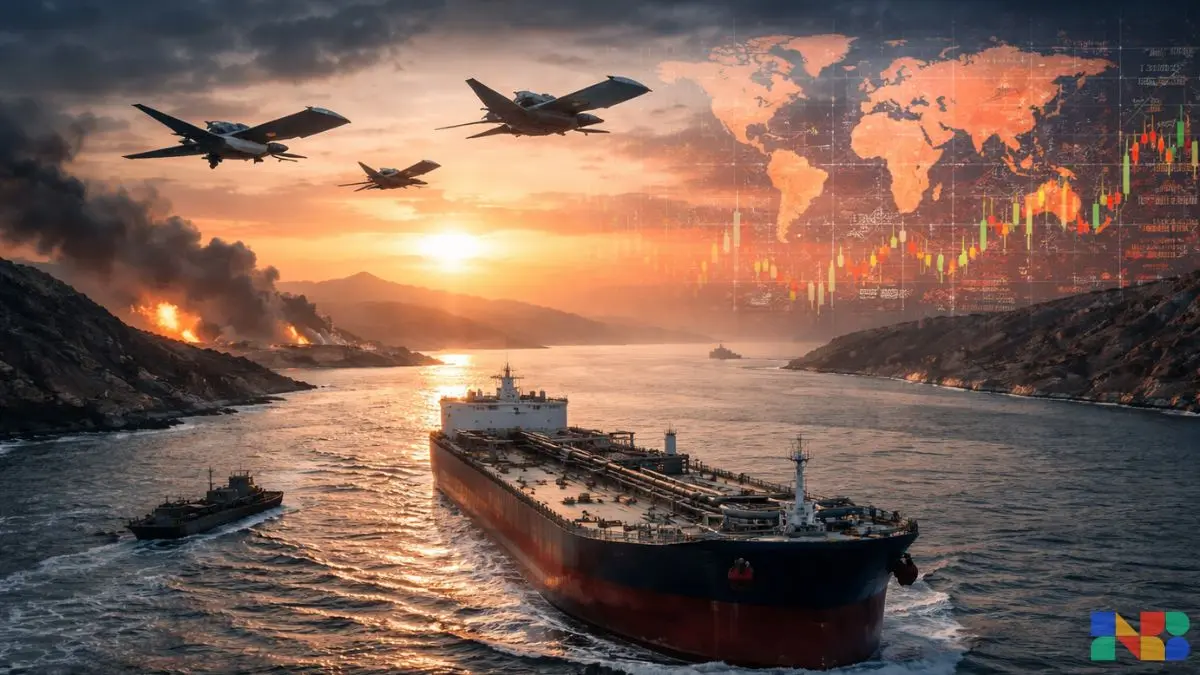
In a statement that could shape the next phase of the Middle East crisis, US President Donald Trump has said America may wrap up its military campaign against Iran within the next two to three weeks, signalling that Washington may be preparing for an exit even without a formal deal with Tehran.
Speaking to reporters at the White House, Trump said the United States would be “leaving very soon,” while making it clear that the central American objective remains the same: to cripple Iran’s military capability and ensure that Tehran does not move closer to a nuclear weapon. The operation, referred to by the US administration as Operation Epic Fury, now appears to be entering what officials describe as its final stretch.
That headline, however, tells only half the story.
Behind Trump’s confidence lies a region still on edge, an oil market still nervous, and a world still watching the Strait of Hormuz — the narrow but enormously important sea route that carries a massive share of global energy supplies. According to the US Energy Information Administration, flows through the Strait in 2024 and early 2025 accounted for more than one-fourth of total global seaborne oil trade and about one-fifth of global oil and petroleum product consumption. Around 20% of global LNG trade also moved through this route, largely from Qatar.
That is why every word coming from Washington, Tehran or Tel Aviv is moving markets.
After Trump indicated that the war may not continue for much longer, oil prices fell sharply and stock markets rallied across the world. On April 1, Brent crude briefly slipped below $100 a barrel before settling near $102.98, while US crude settled around $100.31. In the equity markets, the S&P 500 rose 2.9%, the Dow gained 2.5%, and the Nasdaq climbed 3.8%, showing how strongly investors reacted to the possibility of de-escalation.
But even as markets breathed easier, the ground reality remained volatile.
US Secretary of State Marco Rubio said Washington can now “see the finish line” in the war, though he also made it clear that the end is not immediate. Rubio suggested that channels of communication with Iran remain open, and that a direct meeting between both sides may still be possible at some stage. That indicates the White House is keeping both military and diplomatic options on the table.
Trump, meanwhile, has struck a harder public tone. He suggested that the US wants to finish off Iran’s ability to threaten the region before stepping back. At the same time, he hinted that a deal remains possible — not necessary, but possible. That dual messaging captures the current American position: force first, diplomacy if it helps secure a quicker exit.
One of Trump’s most striking remarks came on the question of the Strait of Hormuz. Despite the waterway’s central importance to world energy security, he signalled that America may not remain deeply involved in securing it after the campaign winds down. Instead, he publicly pushed other countries — especially those more dependent on Gulf oil — to shoulder more of the burden. He also criticised allies such as the United Kingdom and France for not doing enough during the current conflict.
That argument is not without context. Energy analysts note that Asia has the most at stake if Hormuz remains unstable. MarketWatch, citing energy flow data, reported that in 2024, about 84% of crude oil and 83% of LNG moving through the Strait of Hormuz was headed to Asian markets, especially China, India, Japan and South Korea.
The route is critical not only because of volume, but because alternatives are limited. The EIA says Saudi Arabia and the UAE together may have only about 2.6 million barrels per day of spare pipeline capacity that could bypass Hormuz in case of prolonged disruption. In simple terms, if this passage is badly hit, the world cannot easily replace that flow.
That explains why even talk of a US exit is being read in two very different ways.
On one hand, a shorter war would reduce the immediate danger of further military escalation, civilian casualties and economic fallout. On the other, if Washington leaves before maritime security is fully restored, the pressure could simply shift from the battlefield to the oil market. The war may begin to cool militarily, yet its aftershocks could continue at petrol pumps, shipping lanes and stock exchanges around the world. This is especially important for countries like India, where imported energy costs feed directly into inflation, transport costs and household budgets.
For now, Trump has offered the clearest indication yet that the US does not want an open-ended war. But clarity on the timeline is not the same as clarity on the outcome.
Can the US leave in two to three weeks and still claim strategic success?
Will Iran accept indirect diplomacy after weeks of strikes?
And if Hormuz remains vulnerable, who will guarantee the safety of one of the world’s most important energy arteries?
These are the questions hanging over the region tonight.
Trump may be speaking the language of closure. But for the world, this conflict is not over until the guns fall silent, the shipping lanes reopen, and the oil starts moving without fear again.
