Sony Stops Memory Card Orders Due to AI-Driven NAND Shortage
You probably haven't thought much about memory cards lately. They sit quietly in your camera bag, doing their job, easy to ignore — until they're gone. That moment may be arriving sooner than anyone expected.
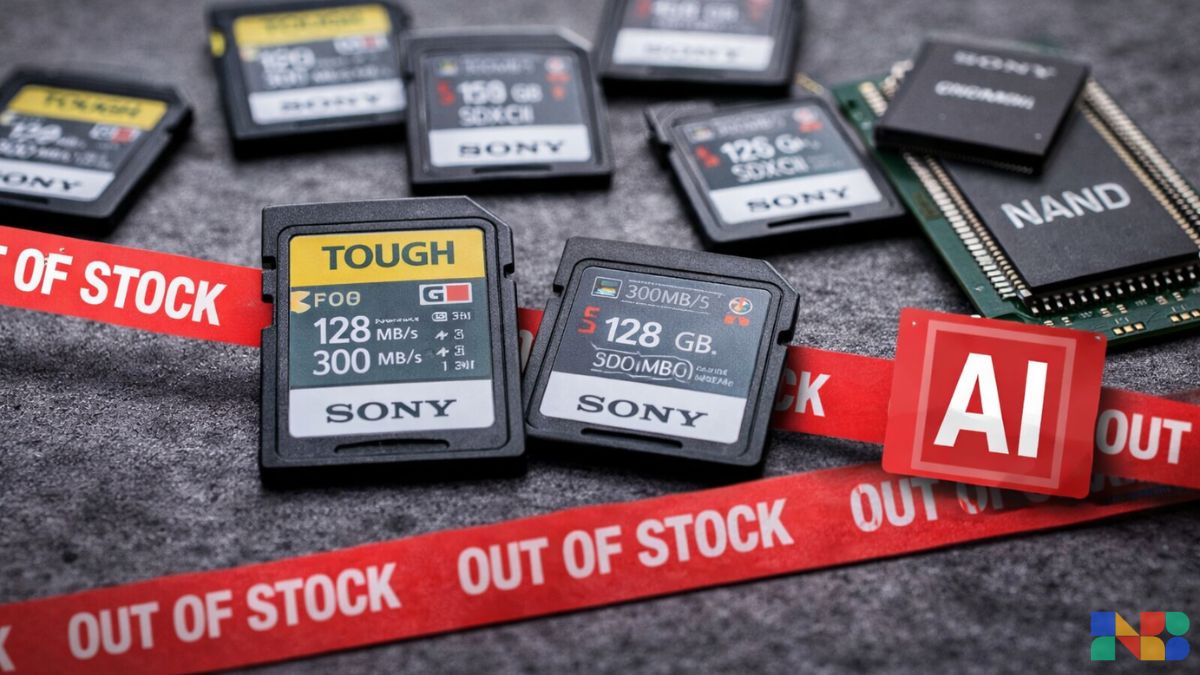
Sony has quietly stopped accepting orders for its CFexpress and SDXC/SDHC memory cards. No dramatic announcement, no press conference. Just a door closing. The culprit? The AI boom has created a NAND flash shortage so severe that Sony simply cannot get its hands on enough of the stuff to keep making cards for photographers and videographers.
The AI Data Center Is a Black Hole
Here's what's actually happening behind the scenes. The same type of NAND flash that goes into your camera's memory card — TLC 3D NAND — also powers the enterprise SSDs that feed data to massive GPU servers running AI models. Training ChatGPT's successors, running inference at scale, storing petabytes of model weights — none of it works without fast, reliable solid-state storage.
Hard drives? Too slow. Enterprise SSDs? Exactly what's needed — and exactly what NAND manufacturers are now making almost exclusively, because the margins are dramatically better.
Why sell to a photographer in Mumbai for ₹8,000 when you can sell to a hyperscaler in Virginia for ten times the profit?
This Isn't a Sony Problem. It's a Canary.
Sony is a $80 billion company with serious procurement muscle. If they can't secure NAND, smaller manufacturers are in serious trouble. The CEO of Phison — one of the most important flash controller companies in the world — had already flagged this months ago, warning that smaller consumer electronics firms could face complete shutdowns by 2026. That warning now looks less like speculation and more like a calendar.
Micron walked this road in December, quietly shutting down its Crucial consumer brand — the one that sold SSDs and RAM to everyday buyers — and pivoting entirely to enterprise customers. Sony is now following the same trail.
When Does It Get Better?
Sony has given no timeline, which is itself a timeline. Industry watchers don't expect NAND production capacity to expand meaningfully enough to serve both enterprise and consumer markets until late 2027, possibly 2028. That's not a typo. We are potentially looking at two or more years of constrained supply.
For Indian content creators — wildlife photographers, wedding videographers, documentary filmmakers — this has real consequences. CFexpress Type A cards, used in Sony's own Alpha mirrorless cameras, are now in a supply freeze from the very company that makes both the cards and the cameras they go into.
The Bigger Picture Nobody's Talking About
The AI gold rush has a shadow economy — and it's being paid for quietly by consumers who don't even know they're footing the bill. The infrastructure appetite of large language models is now directly pulling resources away from products that ordinary people use every day.
Memory cards are just the latest victim. They won't be the last.
The next time someone tells you AI is an abstract, distant technology with no effect on your daily life, remember this: it's already inside your camera bag, taking up space that used to belong to your next memory card.
Tags
Share this article
-B_oZyeHK.png)